
Speed and Convection Microwave Repair
Repairing the browning side of a microwave that also roasts and bakes: the convection element and its fan, the halogen lamps on some speed models, their sensors and relays, and how they share the cavity with the magnetron.
Mon–Sat, 8am–8pm
- Moderate to highest cost band
- 5 steps on the visit
- 6 problems it answers
Book a visit
Three short steps, about a minute.
or call (844) 393-5858
Loading appointment form…
The appointment form couldn’t load. Please try again.
What the speed and convection microwave repair
involves.
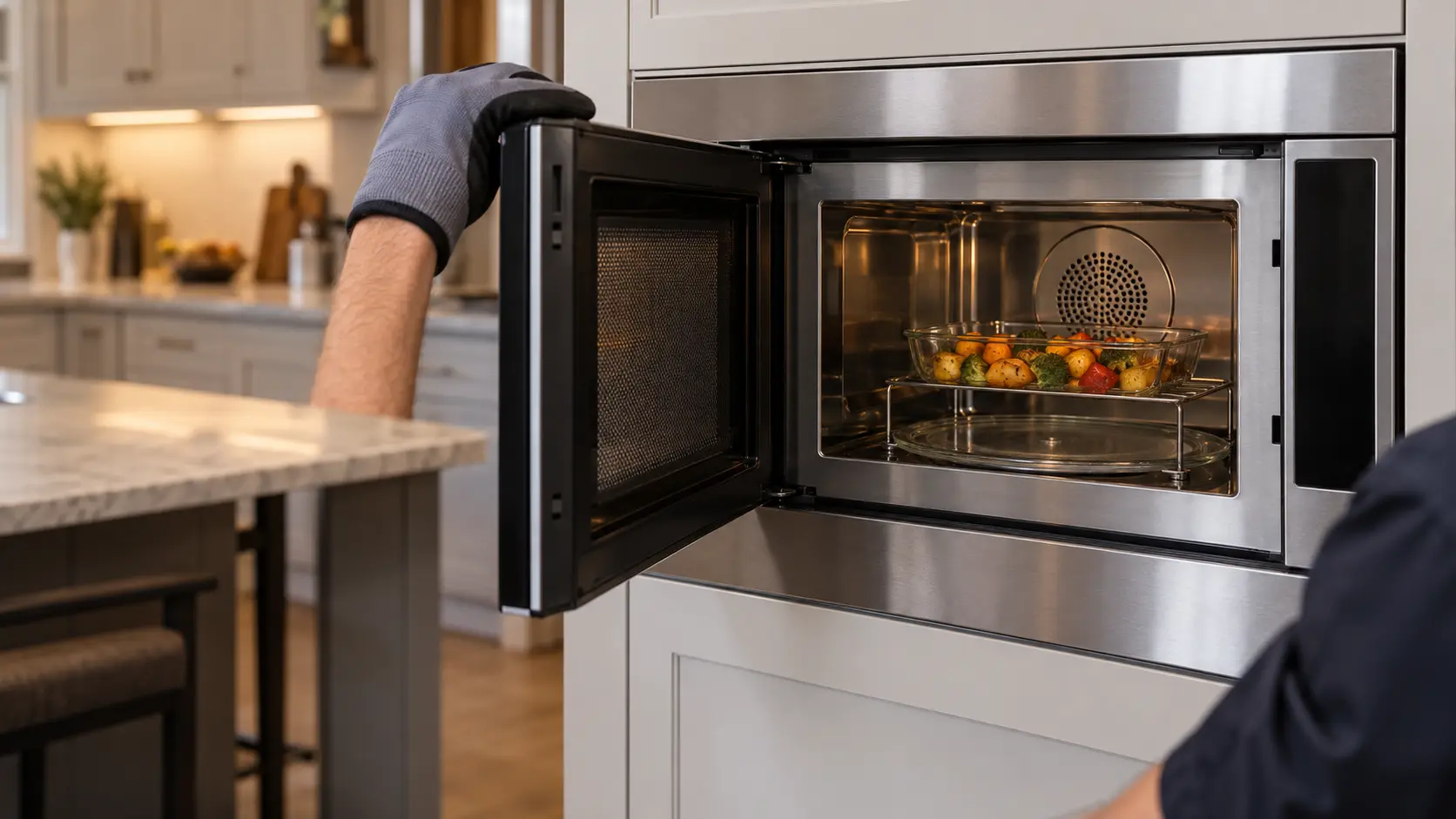
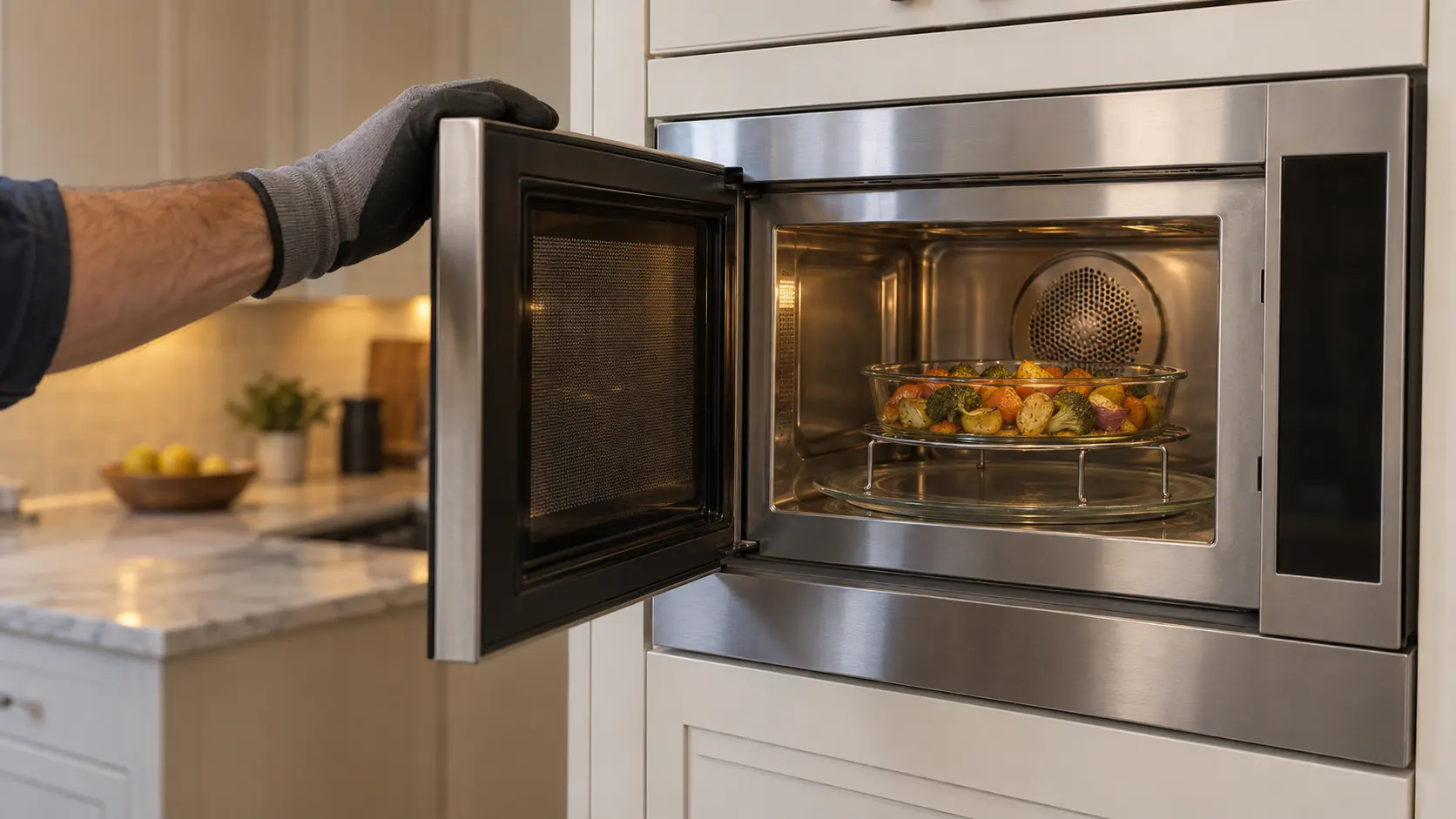
A speed or convection microwave puts a second heat source into the same cavity. Behind the rear wall or above the ceiling sits a heating element with a fan that blows hot air around the food; some speed models add halogen lamps or a browning element that sear the surface, and all of them add a temperature sensor, relays on the board and a longer list of modes. The magnetron still does the fast heating, and in combination modes both run together. That shared cavity means one half can fail while the other works: a unit that reheats a mug but will not bake a potato has a problem on the browning side, while one that browns but leaves soup cold has a microwave-side problem. Convection elements open like any heating element, the hot-air fan motor seizes, a sensor drifts and the board overshoots or undershoots the setting, and a relay that sticks can leave the element on. Because these units run much hotter than a plain microwave, their cooling fans and thermal cutouts matter more, and grease from roasting builds up on the rear panel and the element. The technician tests each heat source separately with the capacitor discharged before any cover is opened, then checks the combination mode with both running.
How the visit goesWhat it usually costsModerate to highest · Convection element, hot-air fan, lamps or sensor
A temperature sensor or a relay is a modest part. A convection element, a hot-air fan motor or a set of halogen lamps for a speed model costs more, and a board made for one premium model sits at the top.
Answers 6 problemsMicrowave Runs but Food Stays Cold
What a Microwave Error Code Is Telling You · Microwave Shuts Off Before the Timer Ends · Burning Smell From a Microwave · Microwave Fire: Smoke or Flames Behind the Door · Microwave Display Dark, Dim or Scrambled
Comes up most onBuilt-in microwave
Microwave hood combination · Countertop microwave
Speed and convection microwave repair,
step by step.
Run every mode again, show you the cavity reaching its set heat, and explain how to keep the rear panel clean.
Run plain microwave power, then convection or bake, then a combination or speed mode, and measure what each one delivers.
Note any code, and look at the rear panel, the element, the lamps and the cavity for grease buildup or burn marks.
Cut the power, draw the unit forward if it is built in, discharge the capacitor, and test the element, the hot-air fan, the sensor and their relays.
Replace the failed element, fan motor, lamp, sensor or relay, and check the cooling fan and thermal cutouts that protect it.
Run every mode again, show you the cavity reaching its set heat, and explain how to keep the rear panel clean.
The problems
it answers.
6 of them, from microwave runs but food stays cold to microwave display dark, dim or scrambled.
All problems
Microwave Runs but Food Stays Cold
7 causes, cheapest first
Before you call
Tell us this when you book
- Which modes fail and which still work: plain microwave, convection, broil or browning, speed or combination
- Whether it overheats, underheats, smokes on bake, or shows a code in one mode only
- Whether it is a built-in model, a hood combination with convection, or a countertop convection unit
- Any smell of burning or smoke on the first minutes of a convection cycle
It also answers
Moderate to highest,
on the site's scale.
A temperature sensor or a relay is a modest part. A convection element, a hot-air fan motor or a set of halogen lamps for a speed model costs more, and a board made for one premium model sits at the top.
Read the full cost guide| Repair | Relative cost |
|---|---|
| Magnetron and waveguide cover | |
| High-voltage diode, capacitor, transformer or inverter board | |
| Door interlock switches, latch or hinge | |
| Turntable motor, coupler or roller ring | |
| Control board, keypad membrane or display | |
| Exhaust fan motor, filters or heat switch | |
| Lamp, socket, line fuse or thermal cutout | |
| Drawer drive motor, gear rack, slides or position switches | |
| Convection element, hot-air fan, lamps or sensor | moderate to highest |
Where it
comes up most.
Most bookings: Built-in microwave, Microwave hood combination, Countertop microwave.
All microwave typesOften the same visit


The makes
we see it on.
18 makes on this site, and the speed and convection microwave repair on any of them. Each mark opens that make's own page.
All 18 brandsSpeed and convection microwave repair,
where we come out.
The kitchen, the climate and the building all change how the speed and convection microwave repair goes. These notes are about that, metro by metro.
All service areasTampa BayFL · 31 areas
Tampa Bay condos and newer houses often use a convection microwave in a tall cabinet as their second oven, and when it heats but no longer browns, the repair tests the convection element, its fan and the temperature sensor.
OrlandoFL · 30 areas
In Orlando vacation homes a speed oven may be the only baking tool guests reach for, and a unit that heats but leaves food pale, or stops with a code mid-cycle, is traced to its browning element, fan or thermal cutout.
Miami / South FloridaFL · 47 areas
South Florida tower kitchens often build a speed oven into the wall beside the main oven, and salt air on its relays and element terminals can stop the convection half while the microwave half works, so the repair tests both.
New York MetroNY · 75 areas
Where a New York kitchen has no room for a second oven, a convection microwave does double duty, and when its fan or element fails the owner loses baking entirely, so the repair orders the model's own part before the visit.
HoustonTX · 36 areas
A Houston speed oven that bakes and microwaves in one cycle carries both a magnetron and a heating element, and a unit that shuts off during a long summer bake is often tripping its thermal cutout because its cooling fan is failing.
ChicagoIL · 50 areas
Chicagoland holiday cooking pushes a speed or convection microwave through hours of side dishes, and a browning element that finally burns open shows as a pale crust; the repair replaces the element and the relay that feeds it if needed.
Los AngelesCA · 95 areas
Los Angeles remodels favor a speed oven stacked above the main oven, and only the microwave unit on top is this repair's concern; a speed oven that no longer crisps is tested at its element, its fan and its sensor.
San DiegoCA · 31 areas
San Diego kitchens that run a convection microwave every day of the year wear out its fan first, and a unit that grows loud on convection or browns one side of the dish is repaired at the fan motor and blade.
San Francisco Bay AreaCA · 74 areas
Bay Area cooks often keep a European speed oven in a column of matched units, and its parts come only through the maker's own supply, so the repair confirms the model and the failed part before anything is ordered.

Questions about
the speed and convection microwave repair.
My convection microwave smokes when I bake. Is it broken?
Why does my speed microwave bake but not reheat?
Is a speed or convection microwave worth repairing?
Back to your everyday
Ready to book the speed and convection microwave repair?
Have these to hand: which modes fail and which still work: plain microwave, convection, broil or browning, speed or combination, whether it overheats, underheats, smokes on bake, or shows a code in one mode only, whether it is a built-in model, a hood combination with convection, or a countertop convection unit, any smell of burning or smoke on the first minutes of a convection cycle.