
Microwave
High-Voltage Diode and Capacitor Repair
Testing and renewing the diode, the capacitor, the transformer or the inverter board that feed the magnetron, the one part of a microwave where a stored charge makes owner repair dangerous.
Mon–Sat, 8am–8pm
- Moderate cost band
- 5 steps on the visit
- 5 problems it answers
Book a visit
Three short steps, about a minute.
or call (844) 393-5858
Loading appointment form…
The appointment form couldn’t load. Please try again.
What the microwave high-voltage diode and capacitor repair
involves.
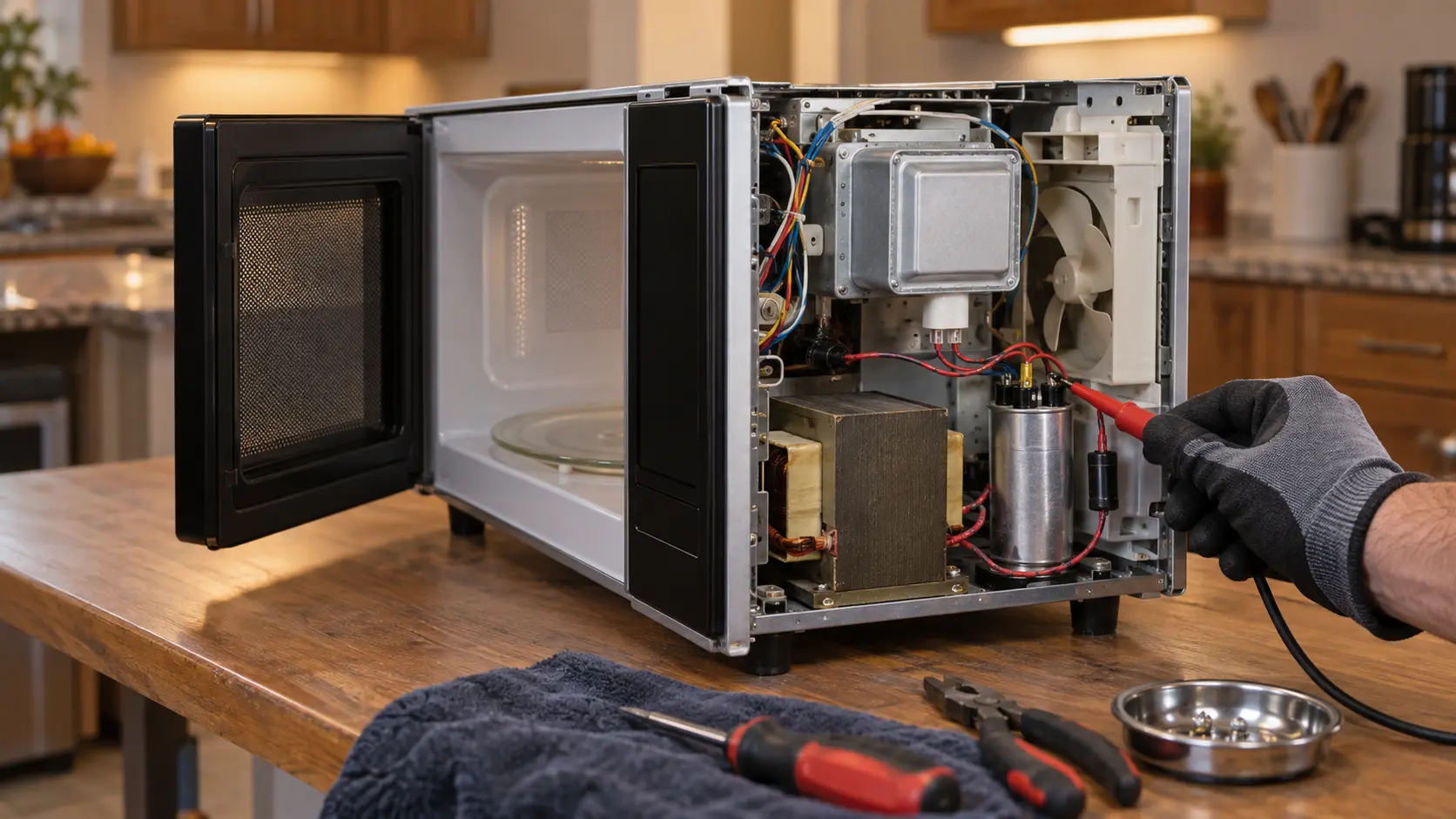
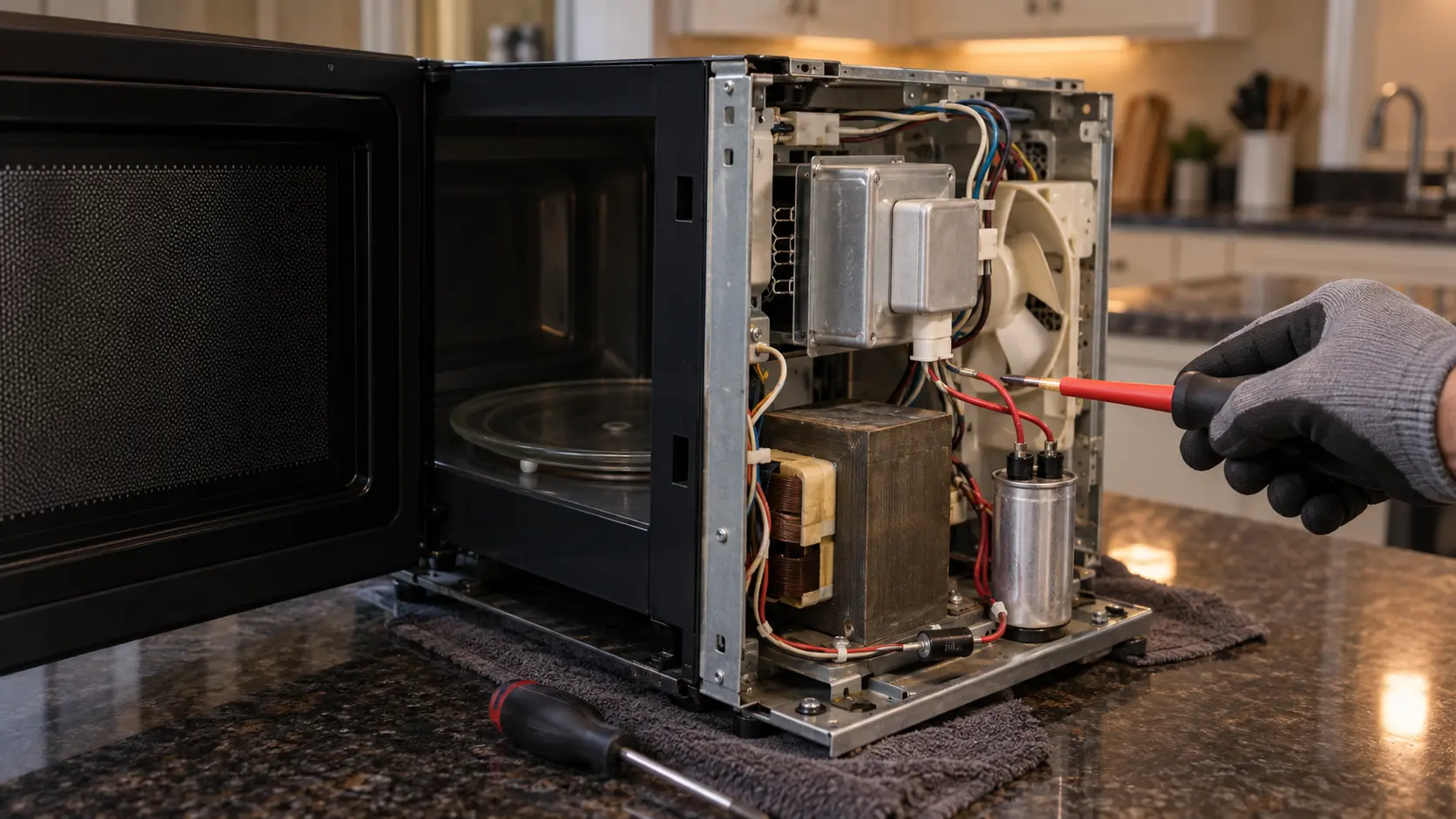
Between the wall outlet and the magnetron sits the high-voltage section, and in most microwaves it is a transformer, a diode and a capacitor working together to push thousands of volts into the tube. Newer inverter models replace the heavy transformer with a circuit board that does the same job. The capacitor is the dangerous part: it stores a charge that can stay behind for days after the microwave is unplugged, and it is why this site never asks an owner to take the outer cabinet off. When the diode shorts, the capacitor fails or the transformer's winding breaks down, the microwave usually runs with its light and turntable going but does not heat, often with a deep hum or a buzz, and sometimes it trips the breaker or blows its internal fuse the moment it starts. The technician discharges and confirms the capacitor before anything else, then tests each part on a meter against the values it should read, including the small bleed resistor that should drain the charge on its own. A diode or a capacitor is an inexpensive part; a transformer or an inverter board is a step up. Whatever is replaced, the magnetron is checked too, since a shorted diode can take it with it.
How the visit goesWhat it usually costsModerate · High-voltage diode, capacitor, transformer or inverter board
A diode or a capacitor is an inexpensive part, fitted once the stored charge has been drained and confirmed. A transformer or an inverter board costs a clear step more, and a shorted diode that took the magnetron with it moves the job toward the top.
Answers 5 problemsMicrowave Runs but Food Stays Cold
Loud Hum, Buzz or Grinding From a Microwave · Microwave Trips the Breaker or Blows a Fuse · Burning Smell From a Microwave · Microwave Fire: Smoke or Flames Behind the Door
Comes up most onMicrowave hood combination
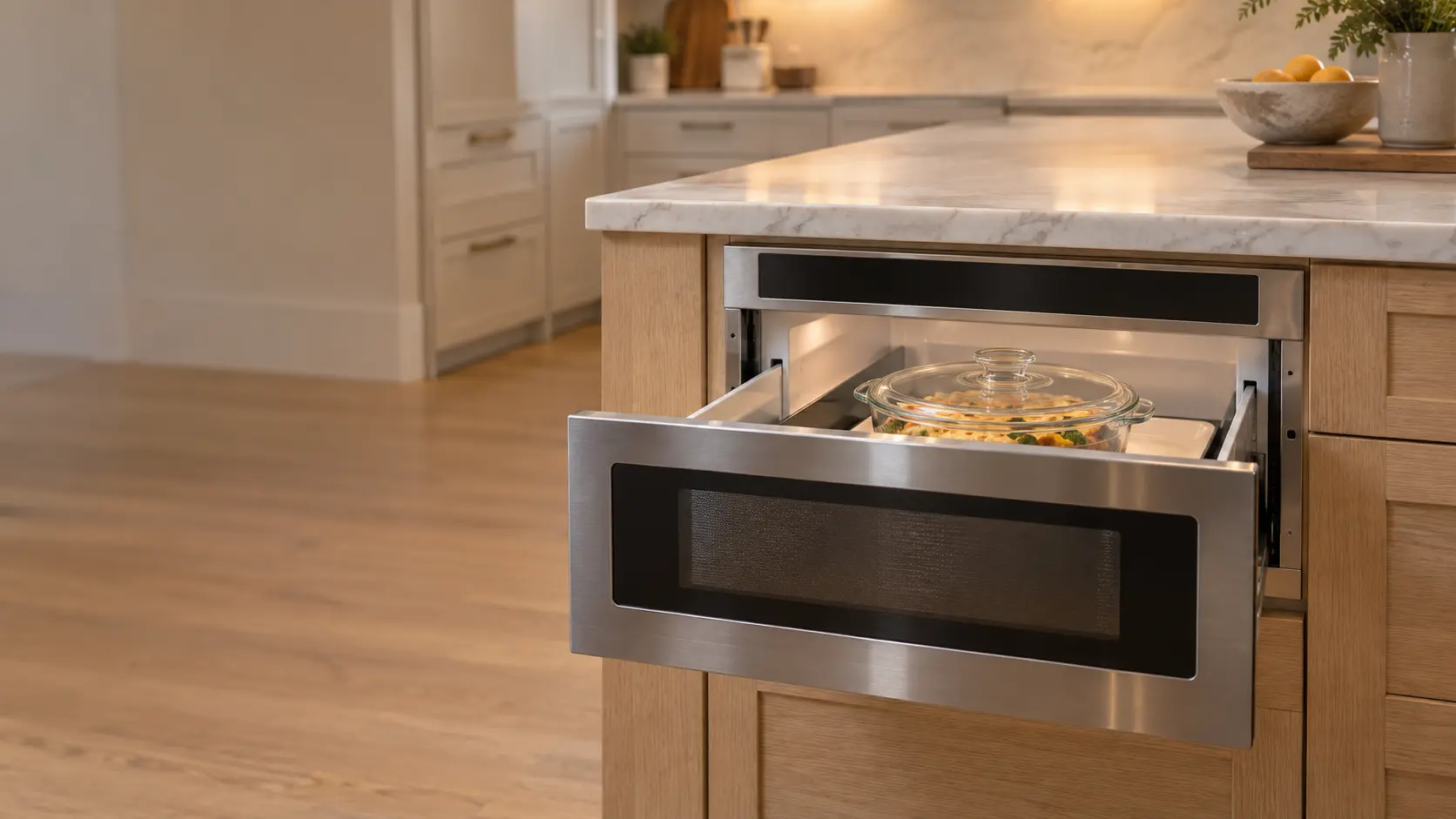
Built-in microwave · Microwave drawer · Countertop microwave
Microwave high-voltage diode and capacitor repair,
step by step.
Close the cabinet, test the door for leakage, and heat water again to show the section is feeding the magnetron properly.
Listen to the hum and heat a cup of water, and note whether the breaker trips or the unit goes dead as it starts.
Cut the power, open the cabinet and discharge the capacitor, confirming zero with a meter before any part is handled.
Test the diode, the capacitor and its bleed resistor, and the transformer windings, or the inverter board on models that use one.
Replace the failed part with one matched to the model, and check the magnetron and the fuse it may have taken with it.
Close the cabinet, test the door for leakage, and heat water again to show the section is feeding the magnetron properly.
The problems
it answers.
5 of them, from microwave runs but food stays cold to microwave fire: smoke or flames behind the door.
All problems
Microwave Runs but Food Stays Cold
7 causes, cheapest first
Before you call
Tell us this when you book
- Whether the microwave hums loudly, buzzes, or makes no unusual sound while failing to heat
- Whether the breaker tripped or the display went dark the moment a cycle started
- Any burning smell, smoke or scorch mark you noticed, and when
- Whether anyone has had the outer cabinet off since it failed
It also answers
Moderate,
on the site's scale.
A diode or a capacitor is an inexpensive part, fitted once the stored charge has been drained and confirmed. A transformer or an inverter board costs a clear step more, and a shorted diode that took the magnetron with it moves the job toward the top.
Read the full cost guide| Repair | Relative cost |
|---|---|
| Magnetron and waveguide cover | |
| High-voltage diode, capacitor, transformer or inverter board | moderate |
| Door interlock switches, latch or hinge | |
| Turntable motor, coupler or roller ring | |
| Control board, keypad membrane or display | |
| Exhaust fan motor, filters or heat switch | |
| Lamp, socket, line fuse or thermal cutout | |
| Drawer drive motor, gear rack, slides or position switches | |
| Convection element, hot-air fan, lamps or sensor |
Where it
comes up most.
Most bookings: Microwave hood combination, Built-in microwave, Microwave drawer, Countertop microwave.
All microwave typesOften the same visit


The makes
we see it on.
18 makes on this site, and the microwave high-voltage diode and capacitor repair on any of them. Each mark opens that make's own page.
All 18 brandsMicrowave high-voltage diode and capacitor repair,
where we come out.
The kitchen, the climate and the building all change how the microwave high-voltage diode and capacitor repair goes. These notes are about that, metro by metro.
All service areasTampa BayFL · 31 areas
Lightning around Tampa Bay drives surges through kitchen wiring, and a microwave's high-voltage diode is among the first parts they take, leaving a unit that hums loudly and stays cold; its capacitor holds a charge even unplugged, so the cabinet stays shut for the technician.
OrlandoFL · 30 areas
Afternoon storms in Orlando blink the power through much of the summer, and a microwave caught mid-cycle can lose its high-voltage diode; the technician drains the capacitor safely before the diode is tested and replaced.
Miami / South FloridaFL · 47 areas
A South Florida condo microwave that growls and blows its fuse after a hurricane outage often has a shorted diode or capacitor, and because that capacitor can hold its charge long after unplugging, the owner leaves the cover on and books a visit.
New York MetroNY · 75 areas
Older New York buildings still see voltage sag when every apartment runs its air conditioner on a July evening, and a microwave that began to buzz without heating after such a night is checked at its high-voltage diode and capacitor.
HoustonTX · 36 areas
After Hurricane Beryl many Houston microwaves came back on the grid or a generator with a harsh buzz and no heat, the familiar sign of a failed high-voltage diode, which the technician replaces once the capacitor is discharged.
ChicagoIL · 50 areas
Long Chicagoland winters keep the microwave busy, and a high-voltage capacitor near the end of its life shows up as a unit that blows its fuse the moment it starts; nobody at home opens the cabinet, since that capacitor stays dangerous unplugged.
Los AngelesCA · 95 areas
Fire-season shutoffs across Los Angeles end with a jolt when the grid returns, and a microwave that hums afterward without warming anything is a common high-voltage diode job, done only after the capacitor has been drained.
San DiegoCA · 31 areas
Backcountry shutoffs in San Diego fire weather restore power with a spike, and the diode and capacitor in a microwave's high-voltage section take it first; a unit that groans without warming the food waits for the technician, not a screwdriver.
San Francisco Bay AreaCA · 74 areas
When a Public Safety Power Shutoff ends in the Bay Area hills, the spike at restoration can reach a microwave's high-voltage section, and a unit that now buzzes and blows fuses has its diode and capacitor tested once the stored charge is drained.

Questions about
the microwave high-voltage diode and capacitor repair.
Why is the capacitor in a microwave dangerous even when it is unplugged?
My microwave hums loudly but does not heat. Is that the diode?
What is an inverter microwave, and is it repaired differently?
Back to your everyday
Ready to book the microwave high-voltage diode and capacitor repair?
Have these to hand: whether the microwave hums loudly, buzzes, or makes no unusual sound while failing to heat, whether the breaker tripped or the display went dark the moment a cycle started, any burning smell, smoke or scorch mark you noticed, and when, whether anyone has had the outer cabinet off since it failed.