


Start with what you own
Microwave
types,
told apart.
The same bowl of oatmeal can warm in four very different machines. A hood combination also pulls steam from the cooking surface below and wears filters, a fan and a lamp; a built-in or speed model is fixed into cabinetry and may carry a browning element and a convection fan; a microwave drawer opens on a motor and a track; a countertop unit is the simplest of all. Knowing which one sits in your kitchen narrows the search before the technician arrives.
Mon–Sat, 8am–8pm
- 4 types
- Serviced in place
- What each one costs
Book a visit
Three short steps, about a minute.
or call (844) 393-5858
Loading appointment form…
The appointment form couldn’t load. Please try again.
Four types,
each its own job.
Each one is built, reached and repaired differently. Open yours for what fails on it and what the work involves.

Microwave hood combination
The microwave that hangs from the wall cabinets above the burners, heating food in its cavity while its own fan, light and filters handle the steam and grease rising from the pans beneath it.

Built-in microwave
A microwave set into a tall cabinet or a wall of cabinetry at eye level, either a countertop body wrapped in a trim kit or a true built-in model, including speed and convection microwaves that brown as well as heat.
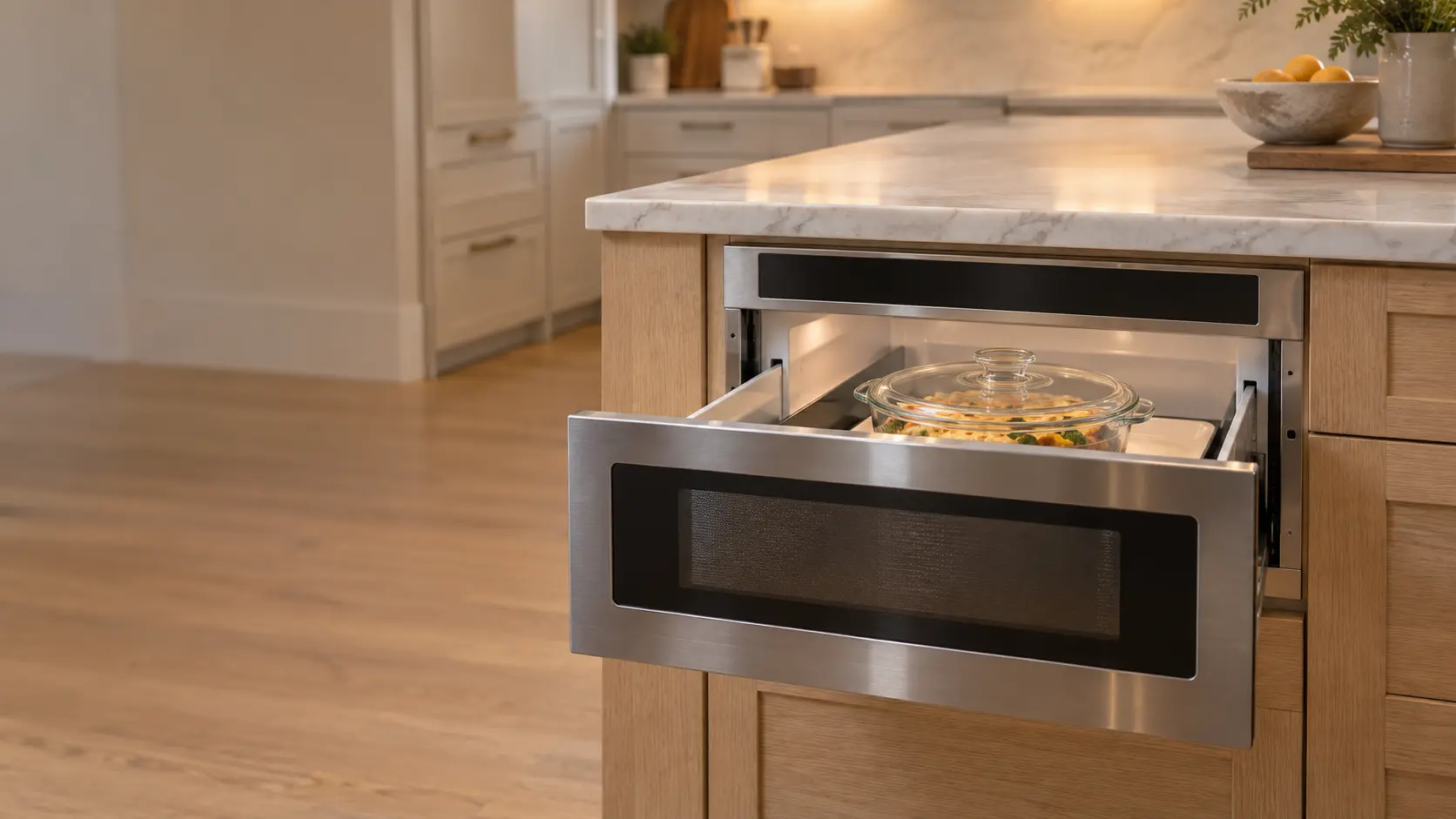
Microwave drawer
A microwave built under a counter or into a kitchen island that opens like a drawer at the touch of a key, with a motor and gears sliding its cavity out toward you.

Countertop microwave
A microwave that stands on the counter or a shelf and plugs into an outlet beside it, from a compact model for a dorm to a large inverter or convection unit in a busy family kitchen.
Not sure which you have?Start from what it is doing
If the microwave in your kitchen does not obviously match one of these, work from the symptom instead. It reaches the same answer from the other end.
17 problemsIn order of costWhat to check first Go to the problemsWhich one
is yours?
One look at the microwave usually settles it. The first sign of each type is on the right; its page has the rest, and what that type means for a repair.
Hood combination, built-in or drawerHood combinationMicrowave hood combination
It hangs under a run of wall cabinets directly above the burners, with its bottom edge roughly level with the tops of your cheekbones.
Built-inBuilt-in microwave
It sits in a cabinet opening at or above counter height, with a steel frame or panel around it that closes the gap to the cabinetry.
DrawerMicrowave drawer
It sits below the countertop, in a base cabinet or an island, with a wide front panel and a control strip across the top edge or on an angled face.
CountertopCountertop microwave
It stands on its own feet on a counter, a cart or a shelf, with a cord running to an outlet behind it or beside it.
What a repair
usually costs.
Weigh a repair against a new microwave for the same place, counting what it takes to put one there: the mounting plate and the two people for a hood combination, the trim kit and the matching finish for a built-in, the cabinet cutout for a drawer. Against that, switches, latches, fuses, lamps, filters and turntable parts are small, and even a magnetron or a board is usually worth it on those three. A countertop microwave is the one exception: nothing about the kitchen changes to replace it, so on a small, older unit a magnetron, a transformer or a main board is often where the technician suggests a new one instead, with both numbers in hand.
| Repair | Relative cost | Notes |
|---|---|---|
| Magnetron and waveguide cover | moderate to highest | A burned waveguide cover alone is a small part. A new magnetron is one of the dearest parts a microwave takes, and on a hood combination or a drawer that has to come out of its mounting the labor adds a step. |
| High-voltage diode, capacitor, transformer or inverter board | moderate | A diode or a capacitor is an inexpensive part, fitted once the stored charge has been drained and confirmed. A transformer or an inverter board costs a clear step more, and a shorted diode that took the magnetron with it moves the job toward the top. |
| Door interlock switches, latch or hinge | low to moderate | A set of interlock switches and the fuse they blew are small parts. A new latch, a hinge on a heavy built-in door or a full door assembly after a bend or a crack costs more, and a leakage reading closes every door job. |
| Turntable motor, coupler or roller ring | lowest | A coupler, a roller ring or a glass plate is among the least costly work on a microwave. The motor under the cavity floor is still a modest part, with a little more time when the unit has to come down from the wall to reach it. |
| Control board, keypad membrane or display | moderate to highest | A keypad membrane or its ribbon sits lower on the scale. A main board, especially one made for a single built-in or speed model and ordered from the maker, is among the costliest parts a microwave takes. |
| Exhaust fan motor, filters or heat switch | low to moderate | Washing the grease filters or fitting a new charcoal filter is the smallest job here. A blower motor, a speed relay or the automatic heat switch costs more, and a motor reached from above means lifting the unit off its mounting plate. |
| Lamp, socket, line fuse or thermal cutout | low | Bulbs, sockets, fuses and thermal cutouts are inexpensive parts. The cost follows what blew the fuse: when the cause is a door switch or a high-voltage part, that repair is priced with it. |
| Drawer drive motor, gear rack, slides or position switches | moderate | Clearing the track and setting the front square sit low. A drive motor, a gear and rack set or a pair of slides, fitted with the unit drawn out of its base cabinet, lands in the middle of the scale. |
| Convection element, hot-air fan, lamps or sensor | moderate to highest | A temperature sensor or a relay is a modest part. A convection element, a hot-air fan motor or a set of halogen lamps for a speed model costs more, and a board made for one premium model sits at the top. |

Questions about
the types.
Which microwaves does this site cover?
Is a hood combination repaired differently from a countertop one?
Do microwave drawers fail in their own ways?
What about my microwave helps the technician most?
Back to your everyday
Let’s get your microwave working again.
Three short steps online, or one call. Tell us what you are seeing and pick a window that works.