


Microwave
Turntable and Motor Repair
Getting the glass plate turning again, from a cracked coupler or a roller ring clogged with spill to the small motor beneath the cavity floor.
Mon–Sat, 8am–8pm
- Lowest cost band
- 5 steps on the visit
- 3 problems it answers
Book a visit
Three short steps, about a minute.
or call (844) 393-5858
Loading appointment form…
The appointment form couldn’t load. Please try again.
What the microwave turntable and motor repair
involves.
A microwave heats in a pattern of hot and cool spots, and the turntable is what moves food through them. The glass plate sits on a three-lobed coupler at the center and rides on a roller ring, and below the cavity floor a small, slow motor turns the coupler. When the plate stops, food comes out scalding at one edge and icy in the middle, and a dish can crack from the uneven heat. The cause is often simple: a coupler split from a heavy dish, a roller ring whose wheels are glued with baked-on sauce, a plate set off its seat, or a turntable key left in the off position on models that have one. Those take minutes. When the plate still refuses to move, or grinds, clicks or turns only when nudged, the motor is tested: on most microwaves it is reached from underneath or through the cabinet, with the capacitor discharged first, and replaced as a unit. The technician also checks the motor's supply from the board, since a failed relay can stop a good motor. On a microwave drawer there is no turntable at all, and on some built-in models a hidden stirrer does the same job; the visit tells you which you have.
How the visit goesWhat it usually costsLowest · Turntable motor, coupler or roller ring
A coupler, a roller ring or a glass plate is among the least costly work on a microwave. The motor under the cavity floor is still a modest part, with a little more time when the unit has to come down from the wall to reach it.
Answers 3 problemsGlass Tray Not Turning in a Microwave
Loud Hum, Buzz or Grinding From a Microwave · Microwave Runs but Food Stays Cold
Comes up most onMicrowave hood combination
Built-in microwave · Countertop microwave
Microwave turntable and motor repair,
step by step.
Run a full cycle to show the plate turning smoothly and food heating evenly, and leave the old parts for you to see.
Lift the glass plate, look at the coupler, the roller ring and the floor seat, and clean the tracks of baked-on spill.
Set the plate back, run the microwave with a cup of water, and watch whether it turns, grinds, clicks or stalls.
Cut the power and discharge the capacitor, then reach the motor under the cavity floor and test it and its supply from the board.
Replace a split coupler, a worn roller ring or the motor, fitting the new one onto its shaft and seat.
Run a full cycle to show the plate turning smoothly and food heating evenly, and leave the old parts for you to see.
The problems
it answers.
3 of them, from glass tray not turning in a microwave to microwave runs but food stays cold.
All problems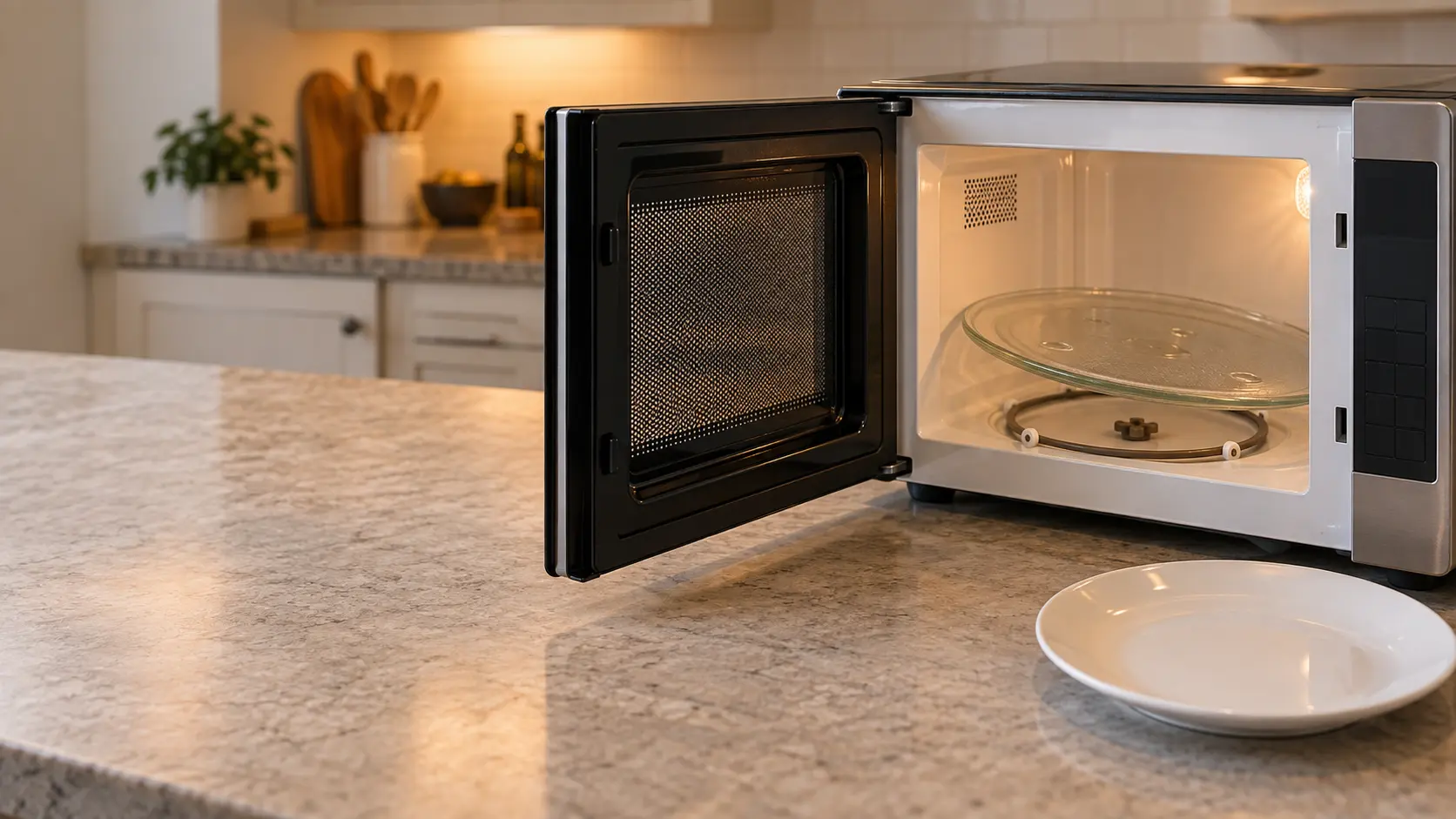
Glass Tray Not Turning in a Microwave
6 causes, cheapest first
Before you call
Tell us this when you book
- Whether the plate stopped completely, turns only sometimes, or grinds and clicks as it turns
- Whether the glass plate, the three-lobed coupler or the roller ring is chipped, cracked or missing
- Whether your model has a turntable on-off key, and whether it may have been pressed
- Whether food heats unevenly now, with hot edges and a cold center
It also answers
Lowest,
on the site's scale.
A coupler, a roller ring or a glass plate is among the least costly work on a microwave. The motor under the cavity floor is still a modest part, with a little more time when the unit has to come down from the wall to reach it.
Read the full cost guideWhere it
comes up most.
Most bookings: Microwave hood combination, Built-in microwave, Countertop microwave.
All microwave typesOften the same visit


The makes
we see it on.
18 makes on this site, and the microwave turntable and motor repair on any of them. Each mark opens that make's own page.
All 18 brandsMicrowave turntable and motor repair,
where we come out.
The kitchen, the climate and the building all change how the microwave turntable and motor repair goes. These notes are about that, metro by metro.
All service areasTampa BayFL · 31 areas
Heavy casseroles from Tampa Bay family dinners crack a microwave's roller ring and wear its coupler, and a glass tray that grinds or stops is repaired with a new ring, coupler or motor fitted beneath the cavity floor.
OrlandoFL · 30 areas
In Orlando rentals the glass tray is often missing, chipped or swapped for the wrong size by an earlier guest, so the repair fits the correct tray, roller ring and coupler before the turntable motor is judged.
Miami / South FloridaFL · 47 areas
Humid South Florida air keeps spills under a microwave's tray tacky, and a roller ring gummed by that residue can stall the turntable motor; the repair cleans the track and replaces the motor if it no longer turns freely.
New York MetroNY · 75 areas
A compact New York microwave whose tray wobbles or stops may simply be carrying a plate wider than its cavity, and the technician rules that out before testing the coupler and the small motor that turns the tray from below.
HoustonTX · 36 areas
Houston households cooking for large families rest heavy dishes on the microwave tray for years, and the turntable motor eventually slows or reverses on its own; the repair replaces that motor from underneath the cavity.
ChicagoIL · 50 areas
Chicagoland winters keep the microwave warming soup and leftovers daily, and a turntable that stops leaves icy centers in every bowl; the fix is a new motor and coupler, reached by the technician from under the unit.
Los AngelesCA · 95 areas
A Los Angeles countertop microwave that clicks and stutters as the tray turns usually has a worn coupler or roller ring, smaller parts than the motor, and the visit replaces whichever one the test points to.
San DiegoCA · 31 areas
Salt air near the San Diego beaches can seize the metal shaft of a microwave's turntable motor, and a tray that stops mid-cycle while the food still warms is repaired with a new motor and coupler.
San Francisco Bay AreaCA · 74 areas
Many built-in and convection microwaves in Bay Area kitchens have no turntable at all and stir the energy with a hidden antenna, so the repair first confirms which design the unit uses before any tray motor or stirrer part is ordered.

Questions about
the microwave turntable and motor repair.
My microwave plate stopped turning. What can I check myself?
Can I keep using a microwave whose turntable does not turn?
Why does my microwave turntable grind or click?
Back to your everyday
Ready to book the microwave turntable and motor repair?
Have these to hand: whether the plate stopped completely, turns only sometimes, or grinds and clicks as it turns, whether the glass plate, the three-lobed coupler or the roller ring is chipped, cracked or missing, whether your model has a turntable on-off key, and whether it may have been pressed, whether food heats unevenly now, with hot edges and a cold center.