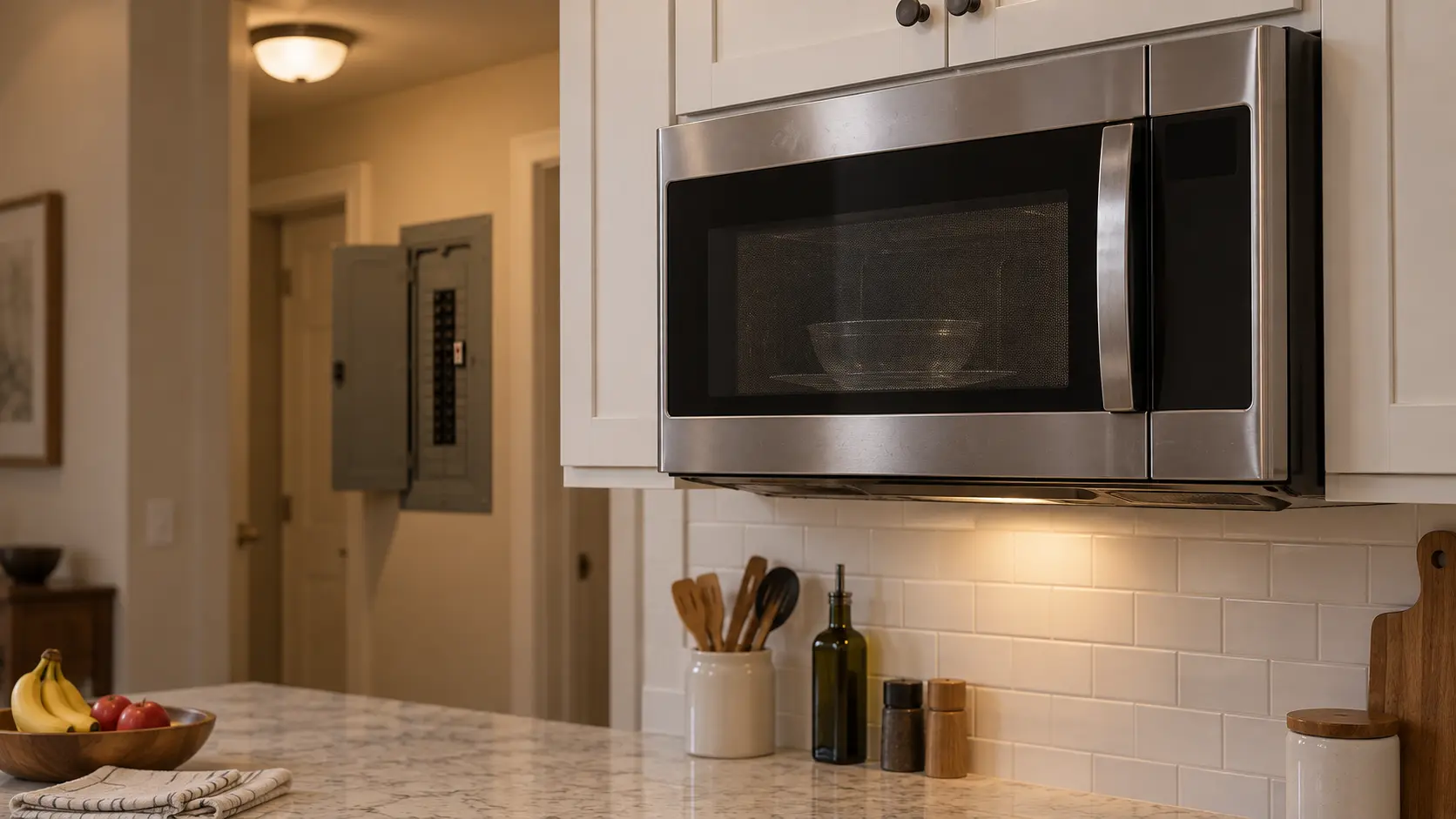


Microwave
Trips the Breaker or Blows a Fuse
A microwave tripping breaker trouble can show the moment the door opens or closes, the second start is pressed, a minute into heating, or only while the kettle runs too, and a microwave that goes dead with its breaker still on may have blown the fuse inside its own case.
Mon–Sat, 8am–8pm
- Stop using it
- 5 questions that narrow it
- 6 causes, cheapest first
Book a visit
Three short steps, about a minute.
or call (844) 393-5858
Loading appointment form…
The appointment form couldn’t load. Please try again.
Door shut, stop pressed, power off at the breaker
One reset with nothing else on the circuit is fine; a second trip means a short, so leave the breaker off. A blown internal fuse is a sign, not the cure: the door switches that often blow it are tested before the microwave runs again, because the next thing they fail to stop is energy with the door open.
What it
usually means.
A microwave draws a large current for its size: the high-voltage transformer pulls well over a thousand watts while it heats, and more for an instant at the start. Built-in units and hood combinations are meant to sit on a circuit of their own for that reason, while countertop models usually share the kitchen's small-appliance outlets with a toaster, a kettle and a coffee machine. When a breaker trips, the first question is whether the circuit is overloaded or the microwave has a short. Inside the case a short can come from the high-voltage capacitor, the diode, the transformer or the magnetron, from a wire rubbed through, or from the door switches. Those switches work as a set: one of them, the monitor switch, deliberately shorts the line if the others fail to open when the door opens, blowing the internal fuse so the magnetron cannot run with the door open. A fuse that blows again right after it is replaced is almost always telling that story. All of it sits behind the outer case beside a capacitor that stays charged, so the owner's side of this problem ends at the breaker panel.
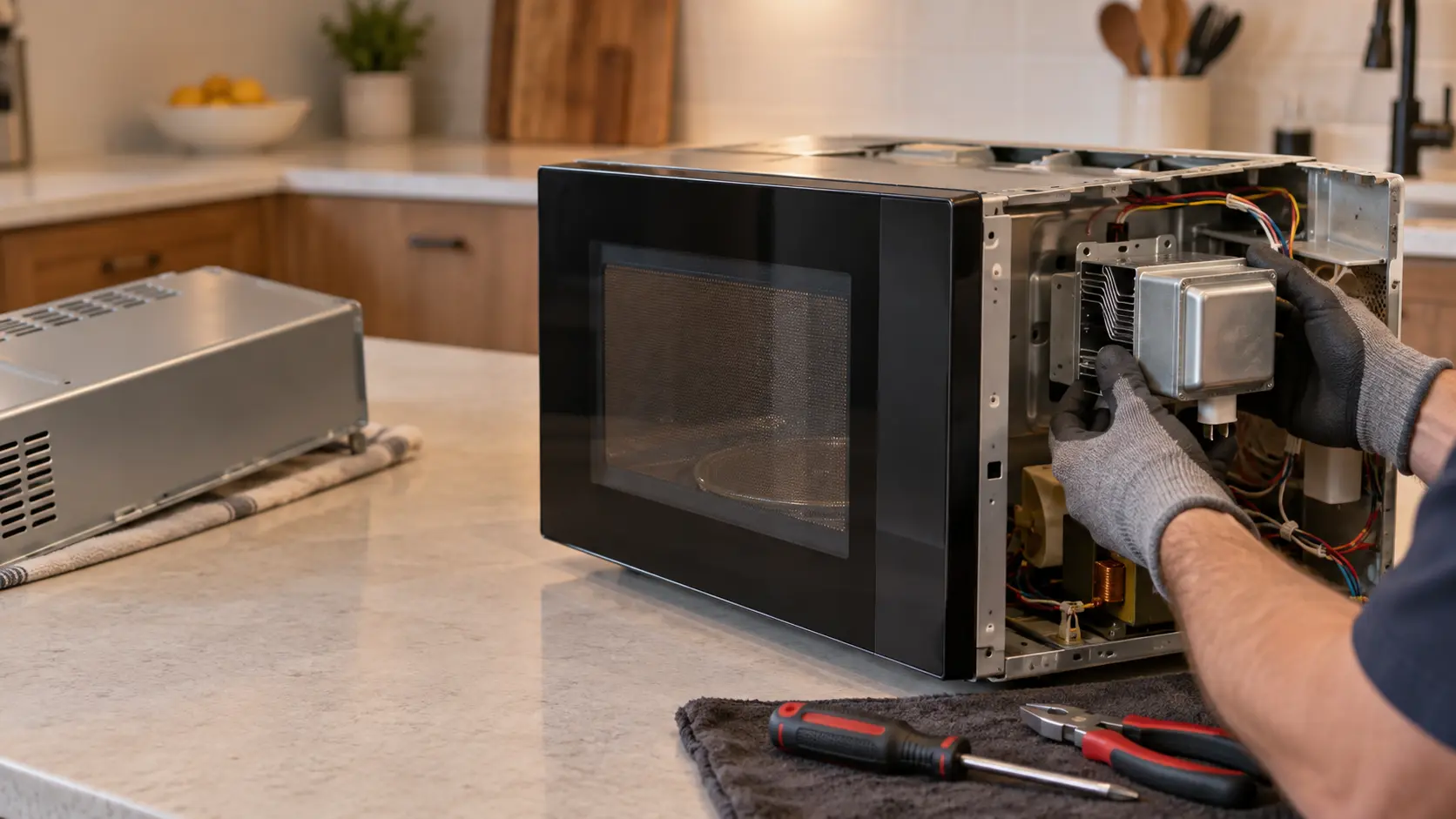 The 6 causes, cheapest first
Answer these first
Does the breaker trip when the door opens or closes, when start is pressed, or after it has heated for a while?
Is it a GFCI or combination breaker, or does a GFCI outlet nearby trip instead?
What else shares the circuit: a toaster, a kettle, a coffee machine, a disposal?
When the microwave goes dead, does the breaker stay on, which suggests the fuse inside it has blown?
Did anything happen just before: a spark, a burning smell, a loud buzz, a door slammed or forced?
Check these
before you book.
Microwave tripping breaker: 5 checks, and none of them costs anything.
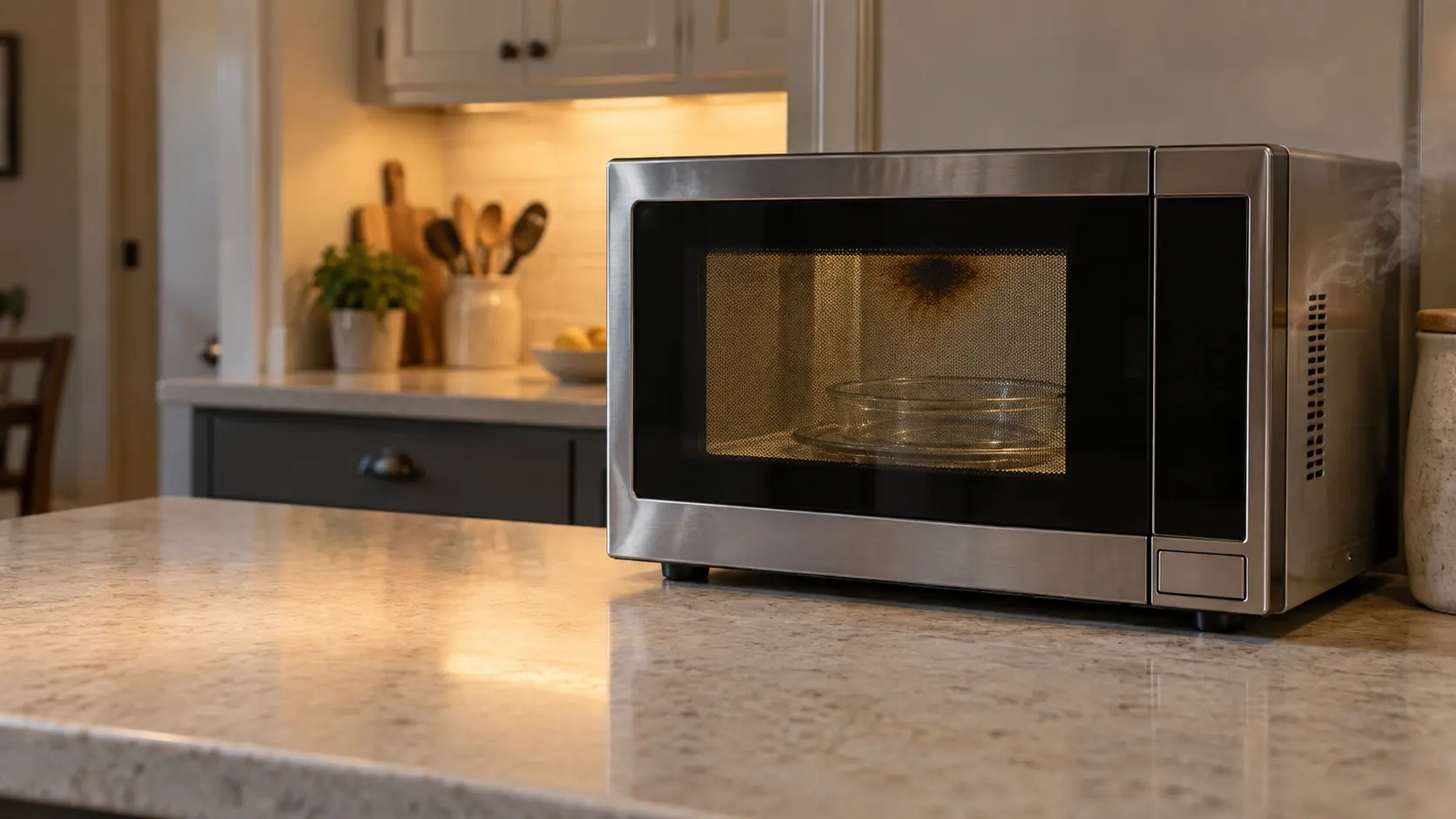
Leave the breaker off if it tripped with a burning smell, a spark or a loud buzz, and do not reset it.
If there was no smell or noise, switch off whatever else shares the circuit, reset the breaker once and try the microwave alone with a cup of water inside.
If it trips again, leave the breaker off and book a visit; repeated resets heat the short and the breaker.
Also worth checking
- Never open the outer case to reach the internal fuse; the capacitor beside it can hold a dangerous charge after the power is off.
- Tell us when it trips, what else is on the circuit, and the model number from the label inside the door frame.
The causes,
cheapest first.
6 things microwave trips the breaker or blows a fuse turns out to be, from a shared kitchen circuit carrying too much to shorted magnetron or transformer.
The cost guide-
01 no repair
A shared kitchen circuit carrying too much
A countertop microwave on the same circuit as a kettle or a toaster can add up past the breaker's rating. If it trips only with both running, move one of them to another circuit; a built-in or hood combination should have a circuit of its own, which an electrician can add.
-
02 low
An internal fuse that simply aged out
A fuse that failed from age, with no short behind it, stays fixed once replaced. It sits inside the outer case, so it is changed on a visit after the switches and the high-voltage parts are tested to show why it went.
-
03 low to moderate
Door switches out of step
When the primary or secondary switch sticks, the monitor switch shorts the line on purpose as the door opens, and the fuse or the breaker goes. A new fuse alone does not fix it: the switches are tested and replaced as a set, and the latch hooks checked for wear.
-
04 low to moderate
A pinched cord or steam in the controls
A cord crushed behind a countertop unit pushed hard against the wall, or steam from the pots below creeping into a hood combination's controls, can trip a GFCI. The cord, its path and the controls are checked first.
-
05 moderate
Shorted high-voltage capacitor or diode
A capacitor or diode that breaks down shorts the transformer's output, and the current on the kitchen circuit jumps with it. The microwave often gives a loud buzz for a second before the breaker lets go.
-
06 moderate to highest
Shorted magnetron or transformer
A magnetron with an internal short, or a transformer whose windings have broken down, trips the breaker every time heating starts. On an older countertop unit the repair can come close to a new microwave; on a built-in or a drawer it rarely does.
What else
it could be.
Most often confused with microwave runs with the door open, then microwave won't turn on at all.
All problemsCodes that come with it
SERVICEBertazzoni · Power and supplyWELCOME PRESS CLEAR AND PRESS CLOCKBertazzoni · Power and supplyWELCOME PRESS CLEAR AND PRESS CLOCKDacor · Power and supplyWELCOME PRESS CLEAR AND PRESS CLOCKFisher & Paykel · Power and supplyWELCOME PRESS CLEAR AND PRESS CLOCKFulgor Milano · Power and supplyE300Gaggenau · Power and supply
Also related

The makes
it happens on.
18 makes on this site; microwave trips the breaker or blows a fuse can show up on any of them. Each mark opens that make's own page.
All 18 brandsMicrowave Trips the Breaker or Blows a Fuse,
where we come out.
9 metros, each with its own page.
All service areasTampa BayFL · 31 areas
Miami / South FloridaFL · 47 areas
New York MetroNY · 75 areas
HoustonTX · 36 areas
ChicagoIL · 50 areas
Los AngelesCA · 95 areas
San DiegoCA · 31 areas

Questions about
microwave trips the breaker or blows a fuse.
Should a microwave have a circuit to itself?
The breaker is fine but the microwave is completely dead. What happened?
Can I replace the microwave's internal fuse myself?
Why does it trip only when I open the door mid-cycle?
Back to your everyday
Still seeing microwave trips the breaker or blows a fuse?
Book with what you checked above — 5 answers save the technician the first part of the visit.