


Built-In
Microwave Repair
A microwave set into a tall cabinet or a wall of cabinetry at eye level, either a countertop body wrapped in a trim kit or a true built-in model, including speed and convection microwaves that brown as well as heat.
Mon–Sat, 8am–8pm
- 4 things that fail on it
- 18 makes build it
- 6 problems it shows
Book a visit
Three short steps, about a minute.
or call (844) 393-5858
Loading appointment form…
The appointment form couldn’t load. Please try again.
Is yours
a built-in?
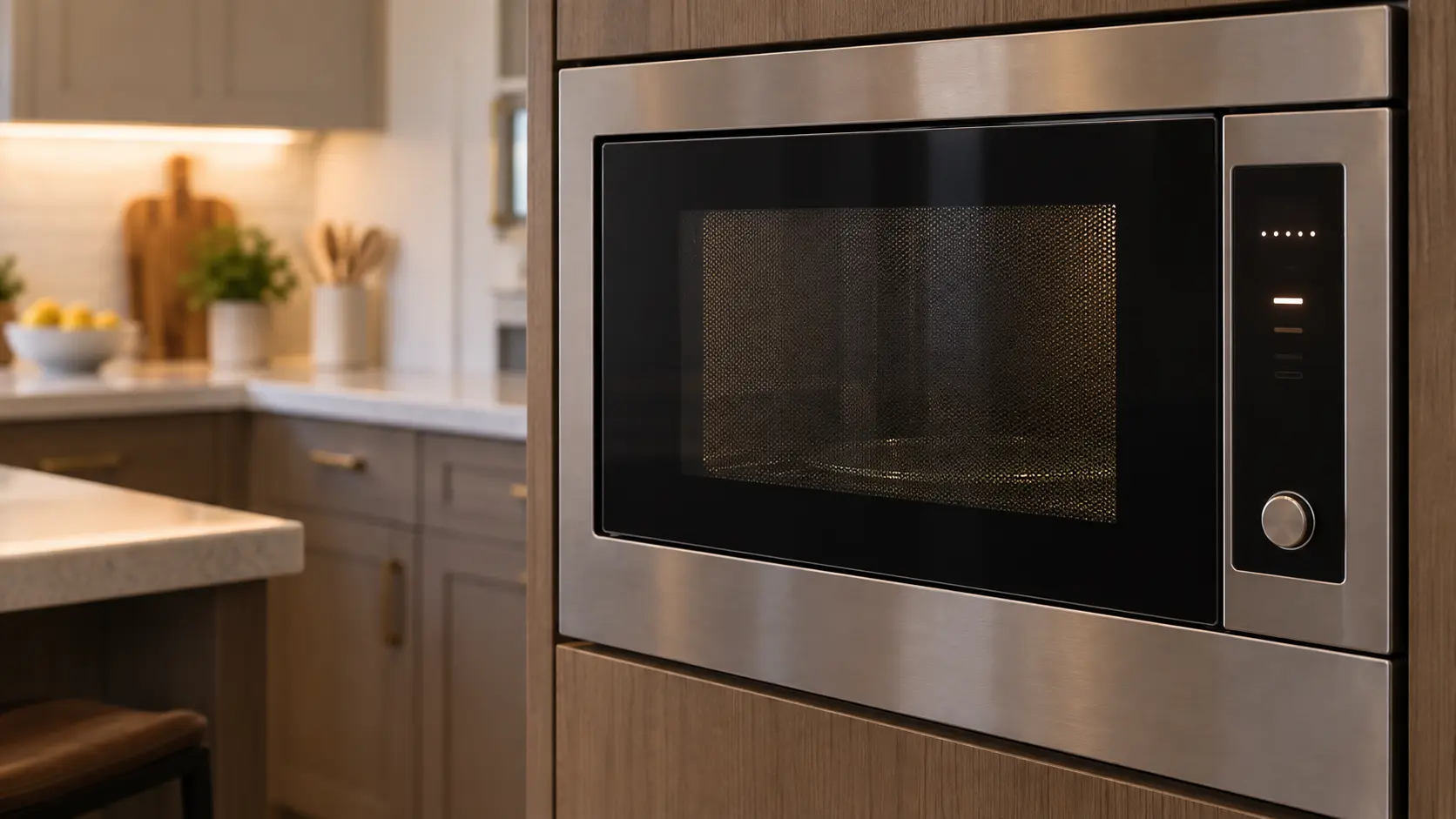
A built-in microwave sits flush in a cabinet opening, often stacked above an oven or tucked into a pantry wall, and comes in two quite different forms. The first is a countertop body slid into a shelf and framed by a trim kit, a steel border that hides the gap and steers the unit's cooling air out through slots around the door. The second is a microwave designed to be built in, with vents only on the front, a door that may open sideways or drop down, and on many premium models a convection element, a fan and sometimes halogen lamps that let it roast, bake and brown food like a second oven. Speed ovens and combination microwaves belong to this family: when their microwave side quits, the browning mode may still work, and the reverse. Because the cabinet around it breathes only through the trim, anything that blocks the front slots, from a tea towel to a new cabinet panel, cooks the electronics slowly. A visit checks that airflow and the trim fit before it pulls the unit forward out of the opening, which needs the screws hidden behind the trim and a clear counter to set it on.
 What fails on a built-in microwave
How to tell
It sits in a cabinet opening at or above counter height, with a steel frame or panel around it that closes the gap to the cabinetry.
There are no vent slots on its sides or top that you can see; the slots are in the trim border or in a strip above or below the door.
The menu or the keys may offer convection, bake, broil or a speed setting beside plain microwave power, which marks a convection or speed model.
A few screws along the bottom or inside the door frame hold it to the cabinet shelf, and the unit does not slide out when you pull on it.
Not yours?Microwave hood combinationMicrowave drawerCountertop microwave
What fails
on this design.
On a built-in microwave: trim vents that cannot breathe, two heat sources in one box, door hinges that carry a heavy door, boards that are hard to replace.
The problems it showsTrim vents that cannot breathe
The trim kit's slots are the unit's only way to shed heat. Blocked by a hanging towel, a pantry door or a panel fitted too close, the cavity and the board run hot, and the thermal cutout starts stopping cycles halfway through a bowl of soup.
Two heat sources in one box
A convection or speed model carries an element, a hot-air fan and sometimes lamps on top of the magnetron. Either half can quit on its own, so a unit that browns but no longer heats a mug, or heats a mug but will not bake, needs each side tested separately.
Door hinges that carry a heavy door
Built-in doors are larger and heavier than a countertop door, and a drop-down door rests its weight on two hinge arms every time a dish is set on it. A sagging hinge pulls the latch hooks out of line with the interlock switches and the unit stops starting.
Boards that are hard to replace
The control and power boards in a premium built-in are made for that model alone. When one fails, the part is often ordered from the maker and some are no longer made after ten or so years, which can decide the repair before anything else does.
Getting at it,
and whether to.
The door, its switches, the turntable or tray, the lamps and the keypad can often be reached with the unit still in its cabinet.
What repairs costOn the visit
- For the magnetron, the high-voltage parts, the convection element or the boards, the trim comes off and the unit slides forward onto a cleared counter or a stand.
- If it is stacked above an oven, tell us so when you book; the oven half has its own site, and we plan the visit around the microwave on top.
- Leave the outer cabinet of the microwave closed and the trim in place until the technician arrives; the capacitor behind it holds its charge after the power is off.
Repair or replace
A built-in microwave is chosen to fill one opening, so a replacement has to match that cutout, the trim kit and often the finish of an oven underneath it. That weighs heavily toward repair: door switches, a hinge, a turntable motor, a lamp, a fuse or a keypad are ordinary work, and even a magnetron is often worth fitting on a speed or convection model. The balance tips when a model-specific board is no longer made, or when a trim-kit countertop body is old and inexpensive to swap for a new one that fits the same trim.
Book a visit for a built-in microwaveThe problems
it shows.
On a built-in microwave, most often microwave runs but food stays cold.
All problems
Microwave Runs but Food Stays Cold
7 causes, cheapest first
Microwave Shuts Off Before the Timer Ends
6 causes, cheapest first
What a Microwave Error Code Is Telling You
7 causes, cheapest first
Microwave Display Dark, Dim or Scrambled
6 causes, cheapest first

Microwave Door Won't Latch Shut
6 causes, cheapest first

Loud Hum, Buzz or Grinding From a Microwave
6 causes, cheapest first
Who builds
a built-in.
18 of the makes on this site build a built-in microwave. Each mark opens that make's own page.
All 18 brandsBuilt-in microwave repair,
where we come out.
9 metros, each with its own page.
All service areasTampa BayFL · 31 areas
Miami / South FloridaFL · 47 areas
New York MetroNY · 75 areas
HoustonTX · 36 areas
ChicagoIL · 50 areas
Los AngelesCA · 95 areas
San DiegoCA · 31 areas

Questions about
built-in microwaves.
My speed microwave still browns food but no longer heats a cup of coffee. Why?
Can I put a regular countertop microwave into my built-in opening?
Why does my built-in microwave shut off halfway through a long cook?
Is a built-in microwave above my oven serviced by the same visit?
Back to your everyday
Is it a built-in microwave?
Say so when you book — it changes what the technician brings and how the visit is planned.