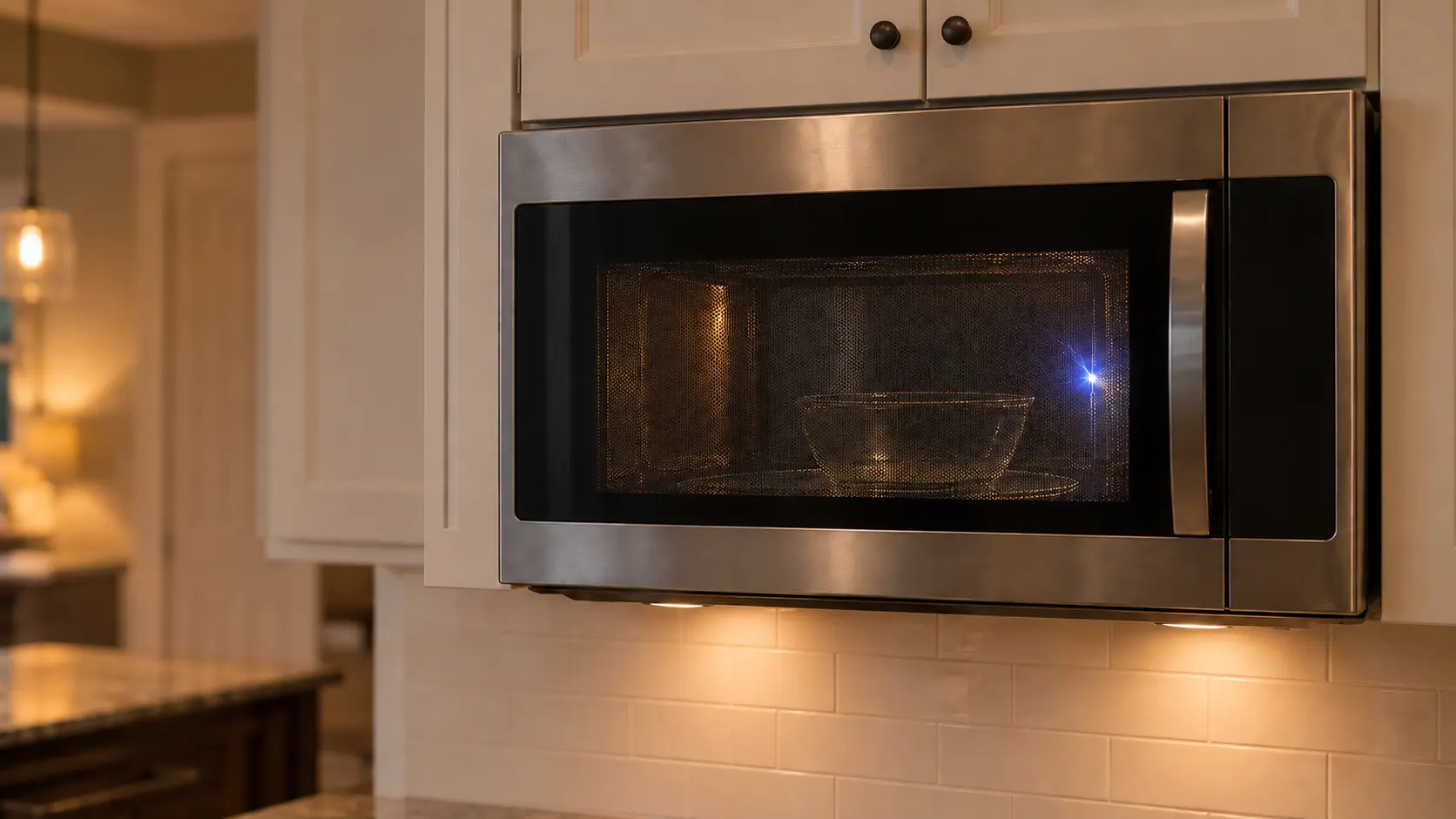


Sparks Flashing Inside a Microwave
A microwave sparking inside shows as blue or orange flashes through the door window, a crackle or snap over the usual hum, and sometimes a scorched dot on the side wall or the ceiling where the flash keeps landing.
Mon–Sat, 8am–8pm
- Stop using it
- 5 questions that narrow it
- 6 causes, cheapest first
Book a visit
Three short steps, about a minute.
or call (844) 393-5858
Loading appointment form…
The appointment form couldn’t load. Please try again.
Door shut, stop pressed, power off at the breaker
Stop the cycle at the first spark and do not run it again, empty or loaded, until the cause is known. If metal was inside and nothing is marked, the unit can go back to work; a burned cover, bare cavity metal, or sparks with nothing metal inside mean a visit before the next use, and the outer case stays closed until then because the capacitor behind it holds a charge.
What it
usually means.
The magnetron behind the control panel makes the energy that heats food and sends it down a short metal channel, the waveguide, which opens into the cooking space through a panel on the side wall or the ceiling. That opening is covered by a thin sheet, usually mica or a pressed board, which lets the energy through and keeps splatter out. Energy that meets a sharp metal edge, a twist tie, the gold trim on a plate or a crumpled corner of foil piles up on it and jumps the gap as a spark. The same happens where grease and sauce have baked onto that cover until they carbonized, and where the paint inside the cavity has chipped down to bare metal. A cycle started with nothing inside is a separate kind of trouble: with no food or water to soak up the energy, it bounces back toward the magnetron, can arc at the waveguide opening, and shortens the magnetron's life. Sparks are urgent because each one burns its spot a little deeper, and a carbon track can become a flame on the next run.
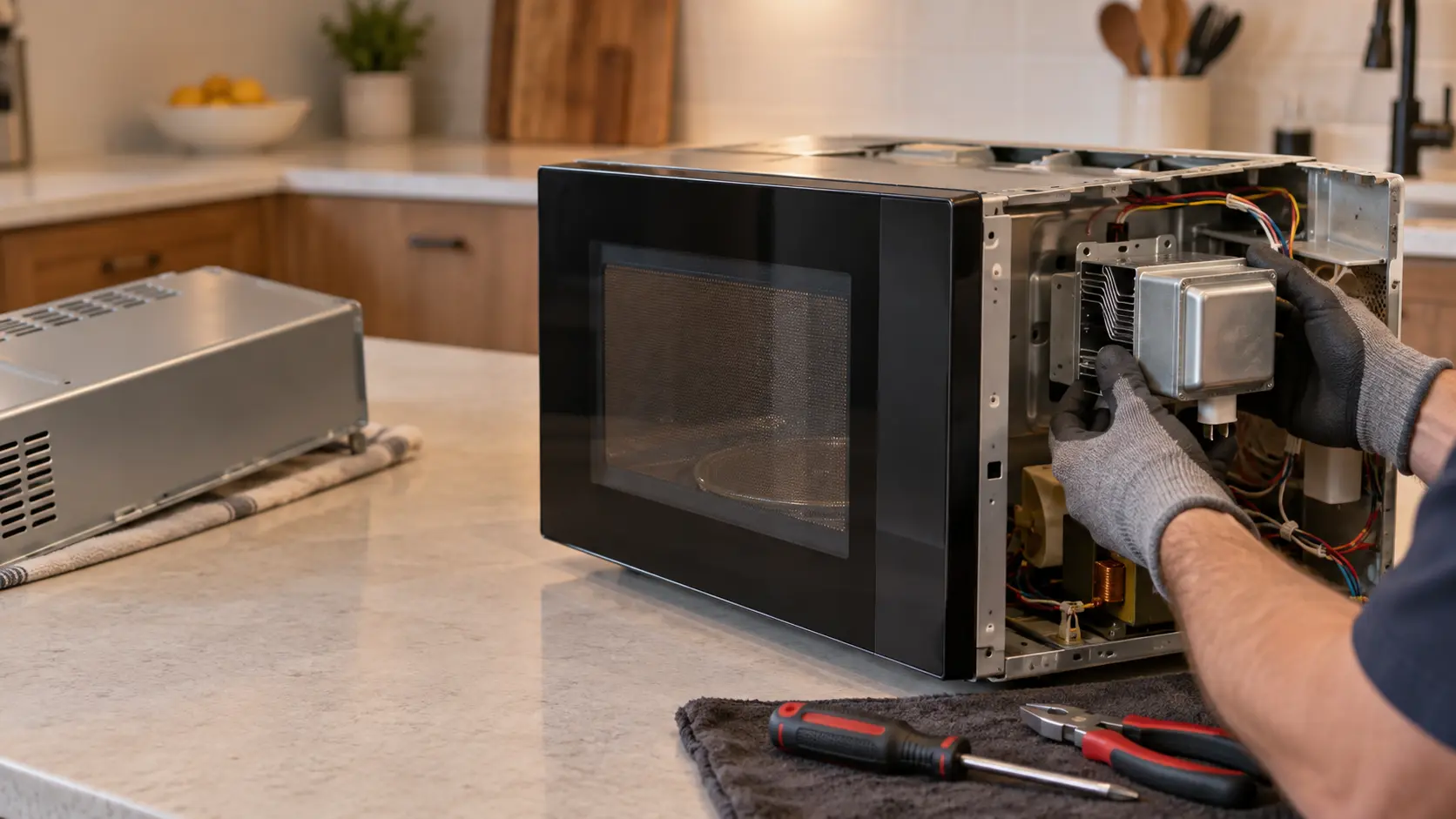 The 6 causes, cheapest first
Answer these first
Where do the flashes appear: at a dish, around the turntable, at the cover sheet on the side wall, or at the ceiling?
Was anything metal inside: foil, a twist tie, a travel mug, a plate with a gold or silver rim, a metal rack?
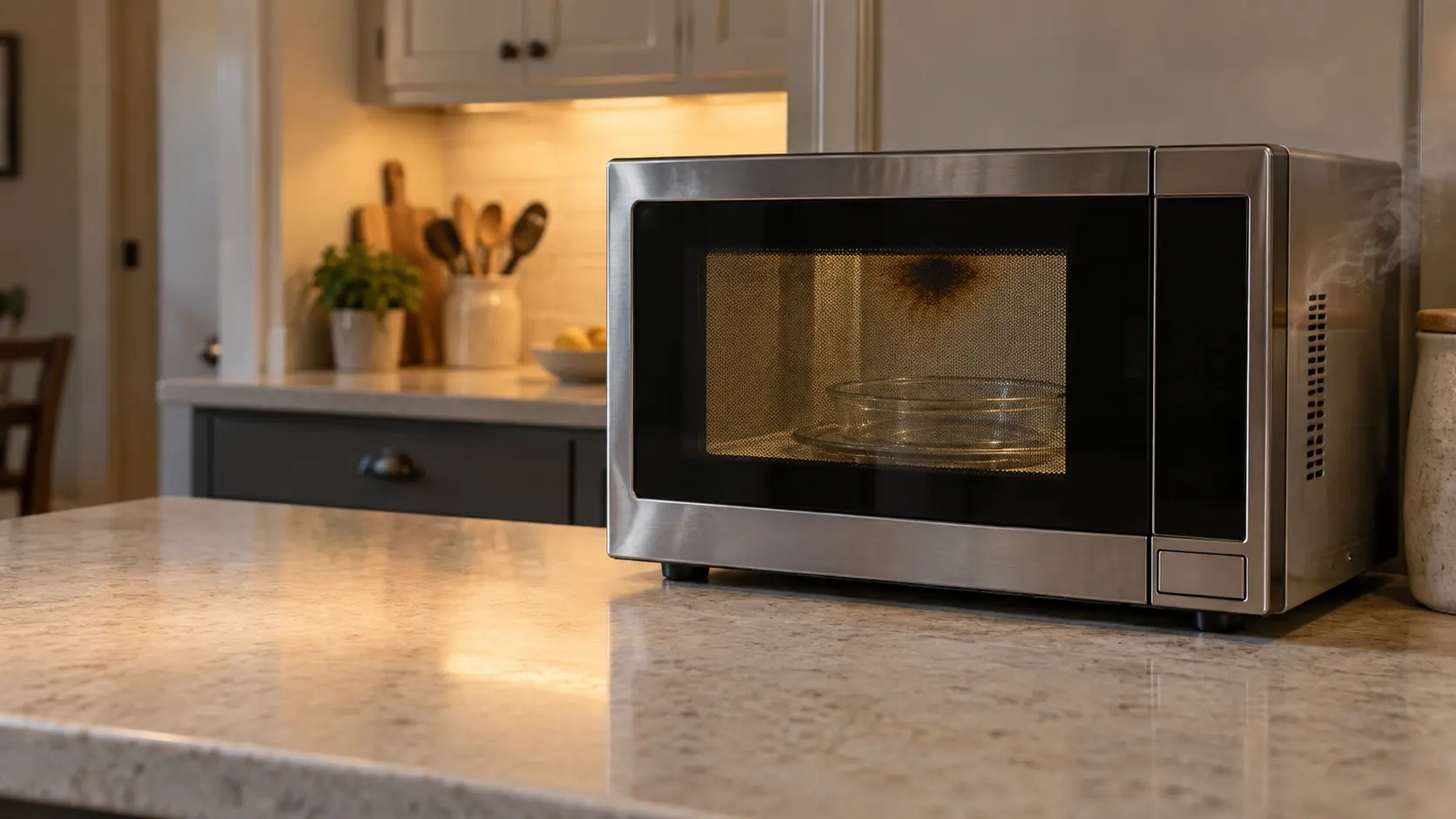
Is there a dark or burned spot on the cover sheet, or a patch where the cavity paint has flaked off?
Did it spark the moment it started, or only after a few minutes with a greasy or sugary food?
Was the microwave started with nothing inside, even for a short time?
Check these
before you book.
Microwave sparking inside: 5 checks, and none of them costs anything.
Press stop or cancel at the first spark, and let the cavity sit with the door closed for a minute before you open it.
Never start it again with nothing inside to see whether it still sparks; an empty run is one of the ways sparks damage the magnetron.
With the unit unplugged or off at the breaker, take out every dish and look for metal, gold or silver trim, foil or a twist tie.
Also worth checking
- Look at the cover sheet on the side wall and at the cavity paint for black spots, burn-through or bare metal, and take a photo.
- Tell us where the flashes appeared and the model number from the label inside the door frame.
The causes,
cheapest first.
6 things sparks flashing inside a microwave turns out to be, from metal or foil inside with the food to magnetron or high-voltage diode breaking down.
The cost guide-
01 no repair
Metal or foil inside with the food
A fork left in a bowl, a takeout carton with a wire handle, foil wrapped tighter than the manual allows or a plate with a metallic rim will arc on nearly any model. Once it is out and the cavity shows no burn mark, the microwave is usually unharmed.
-
02 no repair
A metal rack used in the wrong mode
Speed and convection microwaves come with a metal rack for browning. Some models allow it during plain microwave cooking and others want it out, and a rack touching a wall arcs on almost any of them; the manual for the model settles which.
-
03 low
Splatter baked onto the waveguide cover
Grease and sauce that build up on the cover sheet slowly turn to carbon, and carbon conducts. The spark comes back to the same spot, the cover blackens and in the end burns through, and it has to be replaced before the microwave is used again.
-
04 low to moderate
Chipped paint on the cavity walls
A dish knocked against the wall, or years of scrubbing, can leave bare or rusted metal inside. The rough edge of that spot collects energy the way foil does; a small area can be sealed with the maker's cavity paint, while wide rust often means the unit is near its end.
-
05 moderate
An empty run that hurt the magnetron
A longer run with nothing inside, often a child pressing start or a mistyped timer, sends the energy back into the waveguide. Sparks at the waveguide opening after an empty run point at the magnetron or the cap on its antenna.
-
06 moderate to highest
Magnetron or high-voltage diode breaking down
When the arcing comes from behind the cover and no metal or residue explains it, the magnetron antenna, the diode or the capacitor may be failing. These parts sit behind the outer case with a charge that remains after unplugging, so they are measured on a visit only.
What else
it could be.
Most often confused with microwave fire: smoke or flames behind the door, then burning smell from a microwave.
All problems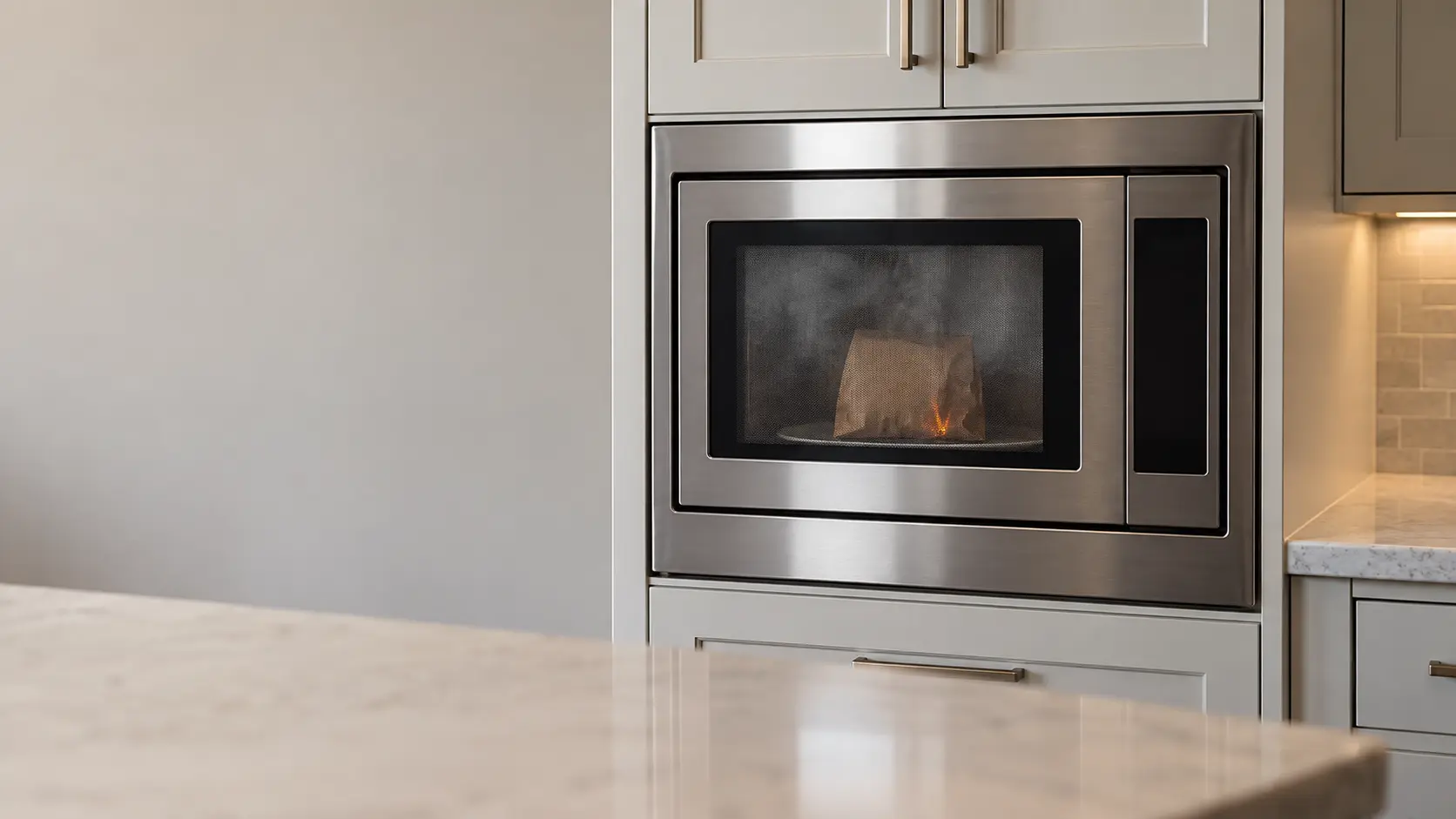


The makes
it happens on.
18 makes on this site; sparks flashing inside a microwave can show up on any of them. Each mark opens that make's own page.
All 18 brandsSparks Flashing Inside a Microwave,
where we come out.
9 metros, each with its own page.
All service areasTampa BayFL · 31 areas
Miami / South FloridaFL · 47 areas
New York MetroNY · 75 areas
HoustonTX · 36 areas
ChicagoIL · 50 areas
Los AngelesCA · 95 areas
San DiegoCA · 31 areas

Questions about
sparks flashing inside a microwave.
Is one spark from a scrap of foil a sign of damage?
Can I replace the cover sheet on the side wall myself?
Why did it spark while heating plain green beans?
Does sparking mean the magnetron is finished?
Back to your everyday
Still seeing sparks flashing inside a microwave?
Book with what you checked above — 5 answers save the technician the first part of the visit.