

Four ways a microwave can be installed
The magnetron, the door interlocks and the control board are much the same whichever form you choose. What differs is where the box sits, how the door opens and what the cabinetry around it demands, and those are the things that decide daily use and later service.
Most kitchens have room for two of the four at most, so the real comparison is usually between a pair: a hood combination against a built-in, or, in a kitchen with an island, the microwave drawer vs built-in microwave question.
- Hood combination: above the cooking surface, fan and light included, bolted to wall and cabinet.
- Built-in: at eye level in a tall cabinet or wall run, framed by trim.
- Drawer: under the counter or in an island, opened by a motor.
- Countertop: free on the counter, plugged into a nearby outlet.
The hood combination above the cooking surface
Often sold as an over-the-range microwave, it hangs from a wall plate and is bolted up through the cabinet above. It carries its own exhaust fan, a work light and metal grease filters on its underside, and it takes the place a separate exhaust unit would otherwise occupy.
The built-in in a tall cabinet or a trim kit
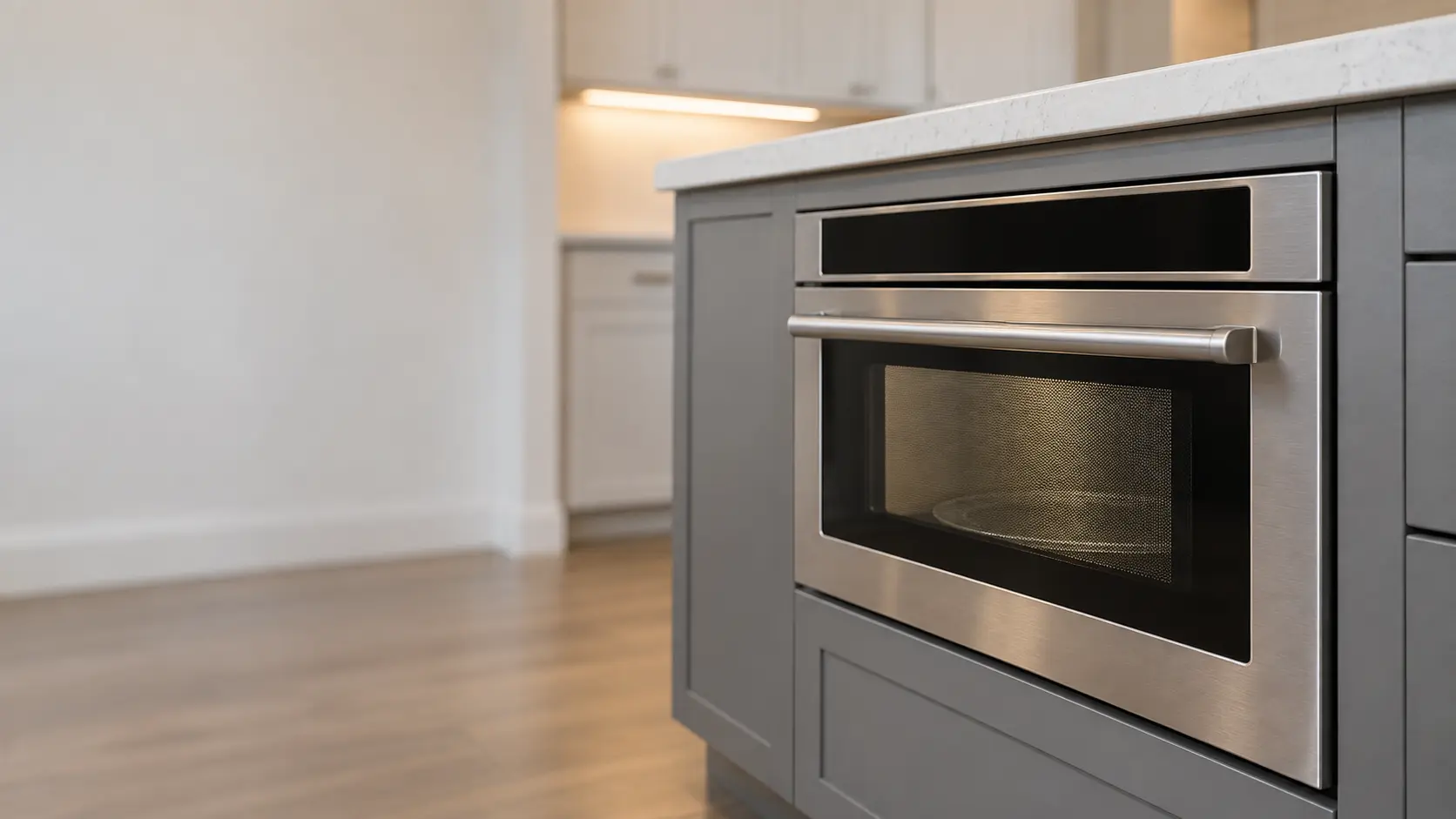
A built-in sits in a cabinet opening, often stacked with other cooking appliances, and is finished with a frame that hides the gap around it. Some are true built-ins vented through the front; others are countertop models dressed in a trim kit sold for that exact model.
The drawer below the counter
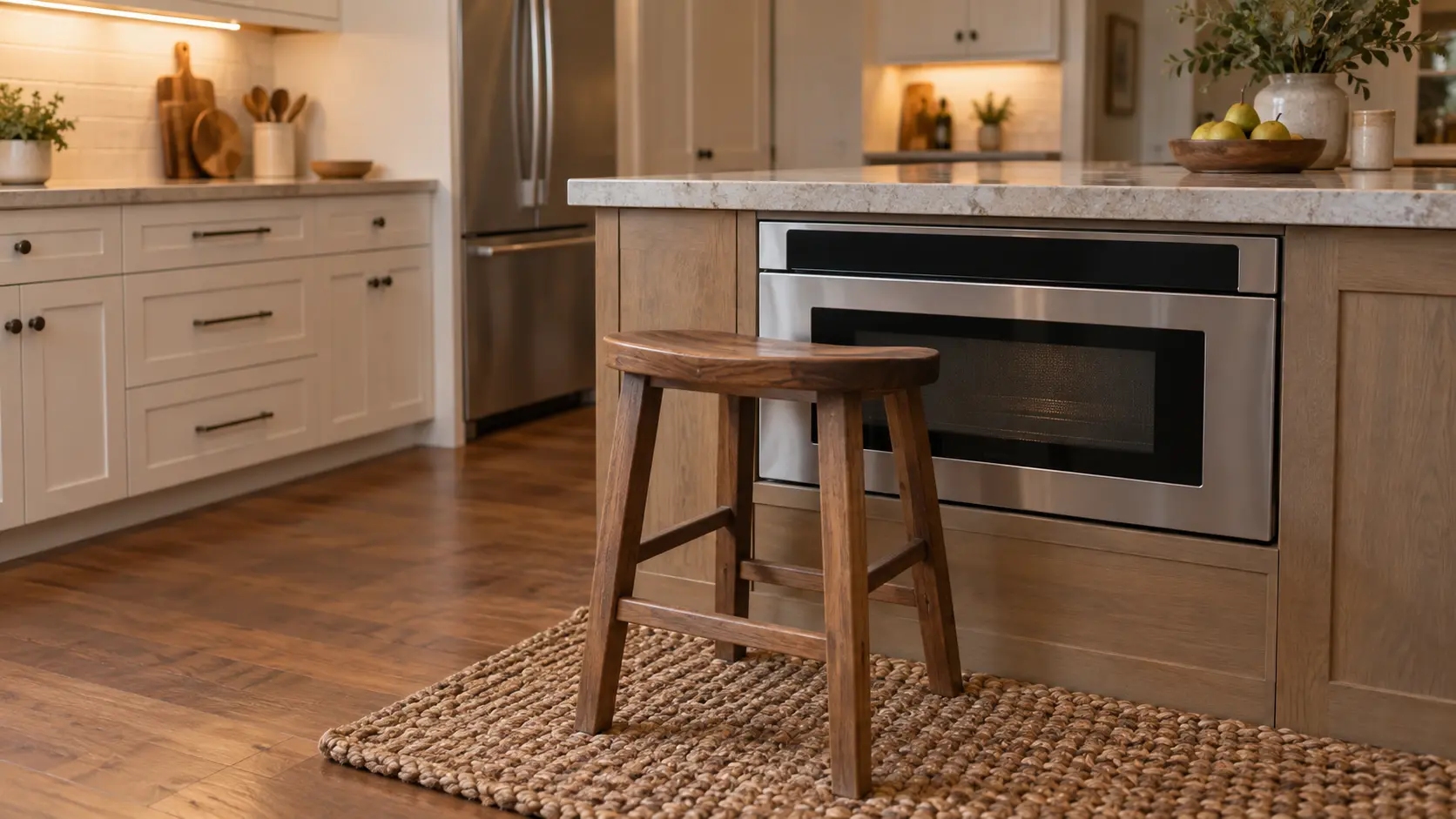
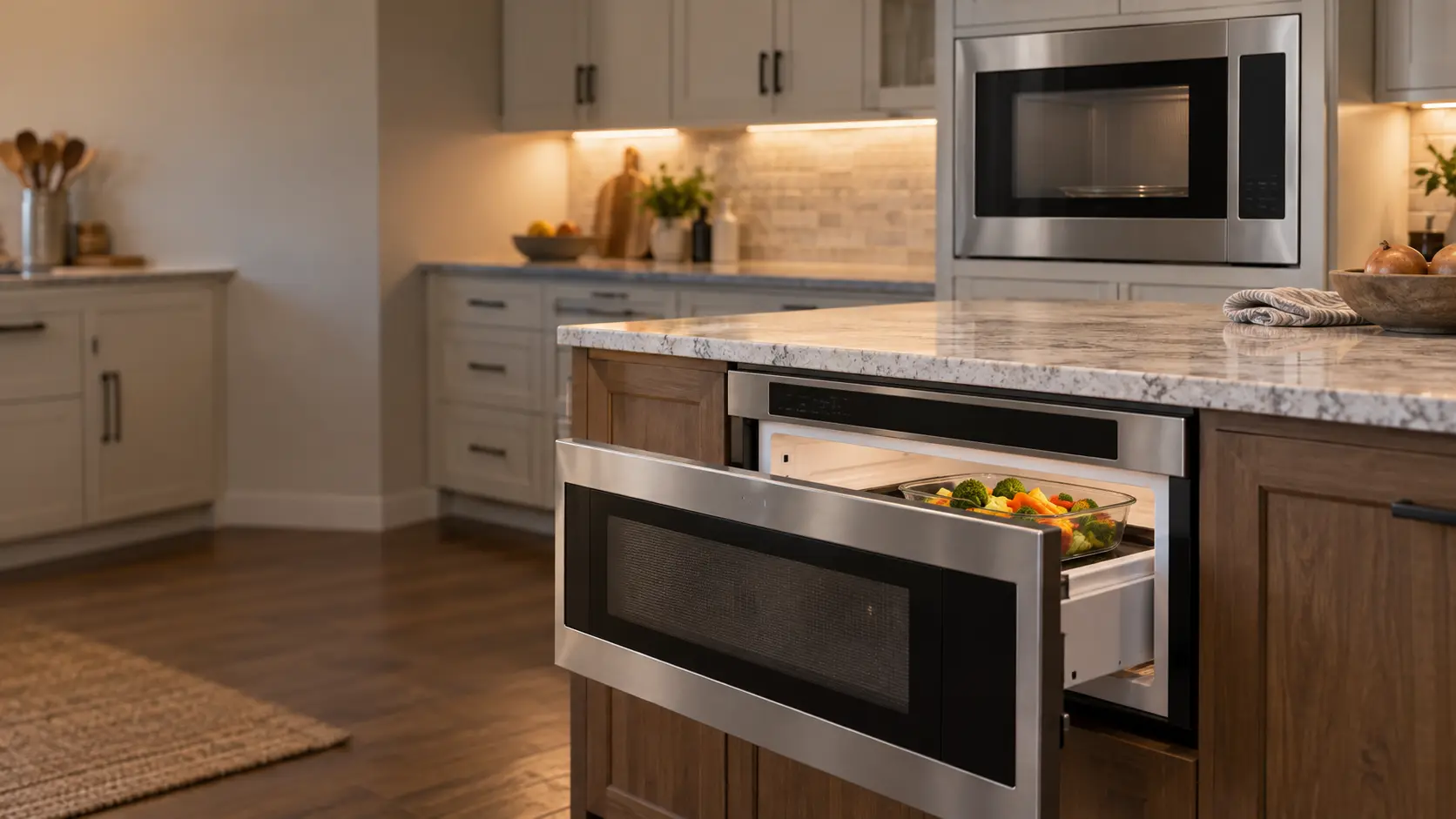
A microwave drawer slides out of a base cabinet or an island on powered guides. The dish goes in from above, the control panel is usually on a touch strip along the top edge, and the whole drawer glides forward and back at the press of a key.
Height, reach and who does the cooking
A bowl of soup that has just boiled is heaviest where it is hardest to hold, which is above your shoulders. On a hood combination the cavity floor is well above the cooking surface, so a short cook reaches up and brings a hot, sloshing dish down past a pan that may still be on the burner below.
The drawer reverses that. You stand over it and lift the dish straight up, the same motion as taking a casserole off a counter. Households with young children should weigh the other side of that low height: the touch strip is within a child's reach, so the control lock described in the manual earns its place.
A built-in placed so its floor sits a little below the elbow of the main cook is the comfortable middle. It keeps the dish at chest height and the door out of a toddler's reach, as long as the cabinet plan allows it.
- Tall and short cooks sharing the kitchen: a built-in or a drawer spares the shorter one the overhead lift.
- Wheelchair users: a drawer or a low built-in keeps the cavity within seated reach.
- Small children: a drawer puts the controls low, so plan to use its lock.
- Frequent large dishes: a built-in usually offers the widest cavity of the fitted forms.
What the fan above the cooking surface can and cannot do
Only the hood combination takes on the second job of clearing steam and smoke from the pans below it. Its metal mesh filters catch grease on its underside, and a manual from GE Appliances says those filters must always be in place when the fan is used, because they also keep flames from the pans away from the inside of the microwave.
A shallow fan in a microwave body moves less air than a deep canopy over a busy six-burner cooking surface, so a household that sears and stir-fries daily often pairs a built-in or a drawer with separate ventilation instead. A household that mostly simmers and steams is usually well served by the combination.
Ducted outside or recirculating
A hood combination either pushes air through a duct to the outside or returns it to the kitchen through a charcoal filter. The ducted setup removes moisture as well as odor; the recirculating one only traps odor and needs its charcoal filter replaced on a schedule.
Source: GE Appliances — Over the Range Microwave Oven Owner's Manual (LVM1335) — The metal grease filters must always be in place when the hood fan is used; they also keep flames from foods below from damaging the inside of the microwave
What each form is like when it needs a technician
Many repairs, such as a door switch, a turntable motor or a touchpad, can be reached on a countertop model at the kitchen table. The fitted forms add a step before any of that: the unit has to come out of its place, and that step is where the forms differ most.
A hood combination is lifted off its wall plate after the bolts through the upper cabinet are removed, a job for two people standing over the cooking surface. A built-in slides forward out of its trim once the frame is off. A drawer comes out on its guides and brings its drive mechanism with it, which also means the guides and the motor become part of what can wear.
- Hood combination: two-person removal, plus the fan, light and filters as extra parts that wear.
- Built-in: trim off, slide forward; ventilation gaps around the frame must stay clear.
- Drawer: powered door and guides add their own repairs; crumbs in the guides slow them down.
- Countertop: carried to a bench, and often replaced rather than repaired.
Source: Wolf — Microwave cleaning (Sub-Zero Group) — A drawer model is not fully removable for cleaning; food crumbs are removed from the drawer guides to keep it opening and closing smoothly
Circuits, cutouts and the small print
Every fitted microwave comes with an installation guide that lists the opening it needs, the outlet position and the circuit it expects. Read it before the cabinet is built, not after: an outlet in the wrong spot behind a drawer or a trim kit is far harder to move than a countertop plug.
The federal standby-power rule treats built-in and over-the-range convection microwaves as their own class, with a separate limit from microwave-only models. A clock and a touch panel draw a trickle all day, and the rule caps how much.
Source: eCFR — 10 CFR 430.32, energy conservation standards (microwave ovens) — Built-in and over-the-range convection microwave ovens have a separate standby-power limit from microwave-only and countertop convection models