Make sure it was actually asked to cook
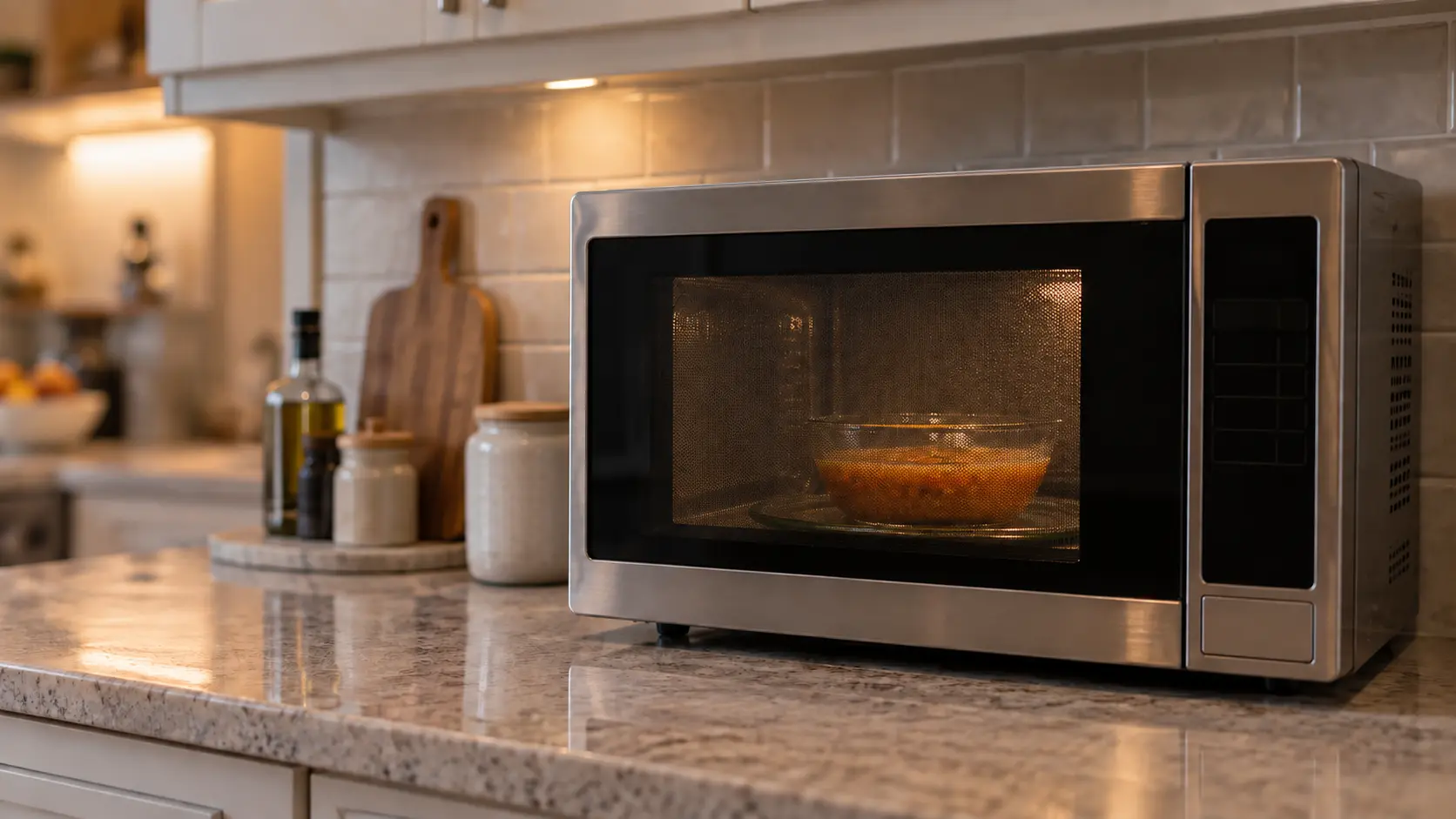
A microwave with the light on, the tray turning and a fan whirring looks as if it is cooking, but those parts run on ordinary household voltage and will carry on even when no microwave energy is being produced. The control decides whether the heating side switches on, and several everyday settings tell it not to.
A kitchen timer instead of a cook time
Most controls have a Timer or Kitchen Timer pad that counts down without heating anything. GE puts this at the top of its list for a microwave that runs cold. The tell is small: on many models a cook cycle shows a power level or a cooking indicator, and a timer does not, and on some models the light and turntable stay off during a timer countdown.
Demo mode that came home from the store
Sharp's microwave drawer has a demonstration mode in which the display counts down quickly and the drawer does not heat, and it sits in the settings menu where a curious thumb can find it. Other makers have their own versions. A countdown that finishes far faster than it should is the giveaway; the guide to reading the display explains how these modes are cleared.
A low power level carried over
Power level 1 or 2, left from defrosting or softening butter, runs the magnetron only a small fraction of the time. The food warms slightly at the edges and the middle stays cold. Press the power pad before starting and check what the display shows; full power is usually labeled High or 10.
- Countdown with no power level shown: likely a timer.
- Countdown much faster than real seconds: likely demo mode.
- Food barely warm after the full time: check the power level.
Close the door firmly, once
Every microwave sold in the US must have two independent interlock systems that stop microwave production as soon as the latch is released or the door opens, according to the FDA. The latch presses small switches inside the frame, and a door that is closed gently or bounces back a fraction can leave one of them unpressed. GE's first advice for a cold microwave is to open the door and close it firmly, so the safety mechanisms engage.
If a firm close fixes it every time, the latch or a switch is on its way out and will get worse. If the opposite happens, and the unit keeps running with the door open, stop using it straight away. The FDA's instruction is plain: a microwave that continues to operate with the door open should not be used.
Source: GE Appliances — Microwave: runs but does not heat — Check that the Timer function was not used by mistake; open the door and close it firmly to engage the safety mechanisms; no do-it-yourself repair advice because an internal high-voltage capacitor can hold a charge after unplugging, and diagnosis needs special equipment; FDA — Microwave ovens — Ovens must have two independent interlock systems that stop microwave production when the latch is released or the door opens; stop using an oven that runs with the door open; microwaves heat the outer layers and the inside cooks mainly by conduction

Hot edges and a frozen middle are not a failure
The FDA describes how microwaves heat: they make water molecules in the outer layers of food vibrate, and the inside of anything thick cooks mostly by heat conducted inward from those layers. A frozen block of chili or a dense casserole will have boiling edges and an icy core after a short run on a perfectly healthy microwave.
Stirring halfway, covering the dish, spreading food into a ring rather than a mound, and letting it stand for a minute or two before eating all help the heat reach the center. A stalled turntable makes it worse, because the same spots sit in the same parts of the cavity for the whole cycle; if the tray stopped turning, fix that first.
Source: FDA — Microwave ovens — Ovens must have two independent interlock systems that stop microwave production when the latch is released or the door opens; stop using an oven that runs with the door open; microwaves heat the outer layers and the inside cooks mainly by conduction
A cup of water tells you which side you are on
Fill a glass measuring cup with a cup of cold tap water, run it for one minute on full power, and touch the water afterward. Warm to hot water means the heating side works and the problem lies in settings, loading or the food. Water that is no warmer than when it went in, after a cycle that sounded and looked normal, points to the heating circuit itself.
Listen while it runs, too. GE explains that at lower power levels the magnetron cycles on and off and makes a dull thump, click or hum as it does. At full power there should be a steady deeper hum on top of the fan. A cycle that sounds exactly like the fan alone, with no change when the magnetron should engage, fits the cold-water result.
Source: GE Appliances — Microwave: normal operational characteristics — Below High power the magnetron cycles on and off, causing a dull thumping, clicking or humming noise
The parts behind the panel, and why they are not a home job
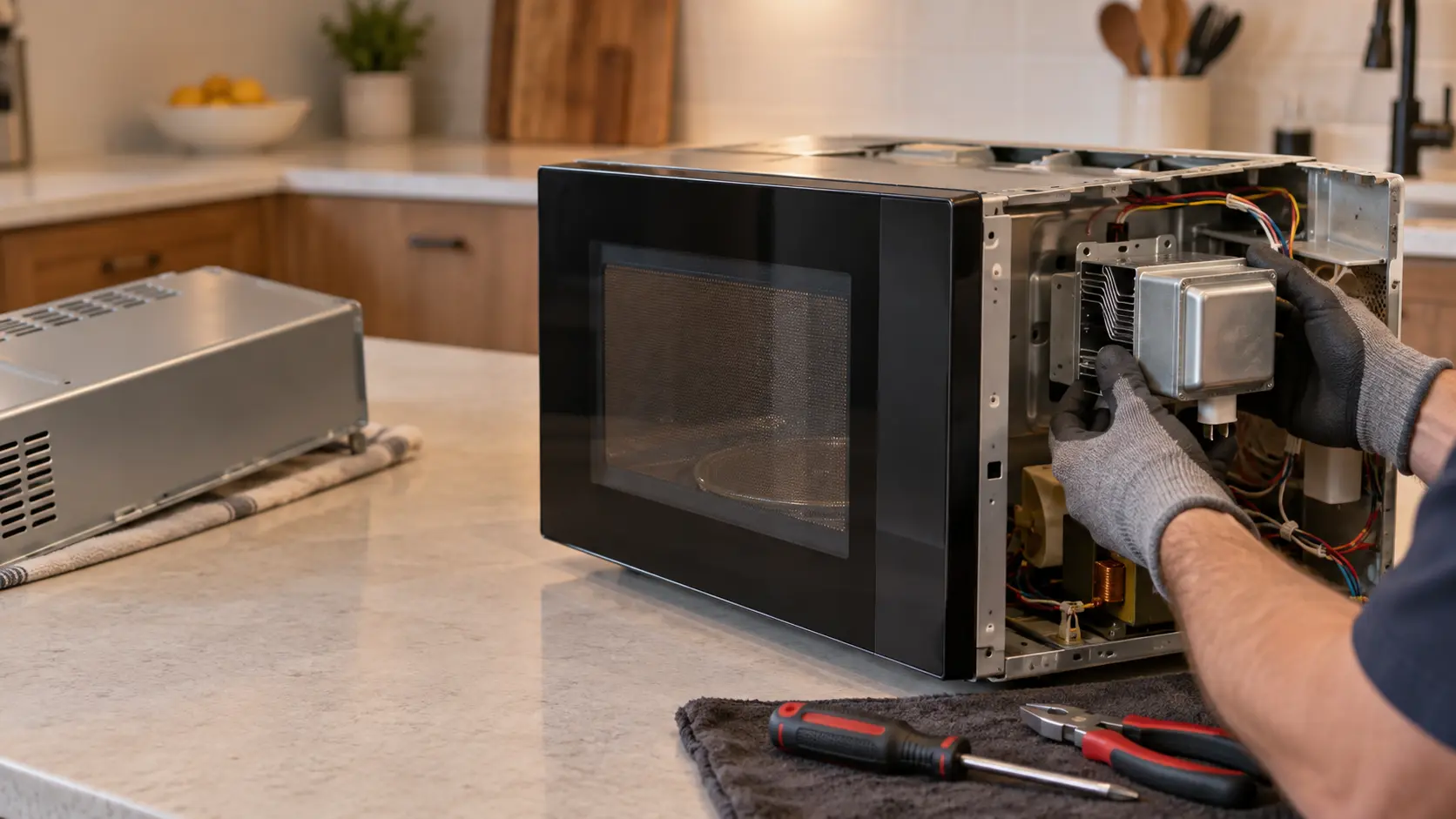
When the settings are right, the door is latched and the water stays cold, the trouble sits in the high-voltage section: the magnetron that makes the energy, the diode and capacitor that feed it, a thermal cutout or high-voltage fuse that protects it, or the board that switches it on. GE explains why it gives no do-it-yourself advice on this at all: an internal capacitor can hold a high-voltage charge even after the microwave has been unplugged, and special equipment is needed to diagnose it.
A technician discharges that capacitor safely and measures each part in turn, which is how a cheap diode is told apart from a tired magnetron. On a countertop unit the answer sometimes favors replacement; on a built-in, a drawer or a hood combination, the trim, the mounting and the matching cabinetry usually make repair the better value.
- Cold water, normal sounds, lights on: high-voltage side, book a visit.
- Cold water and a loud buzz or a burning smell: switch off at the breaker first.
- Heats sometimes, not others: note when, since heat and long cycles narrow it down.
Source: GE Appliances — Microwave: runs but does not heat — Check that the Timer function was not used by mistake; open the door and close it firmly to engage the safety mechanisms; no do-it-yourself repair advice because an internal high-voltage capacitor can hold a charge after unplugging, and diagnosis needs special equipment