
How a closed door keeps the energy in the cavity
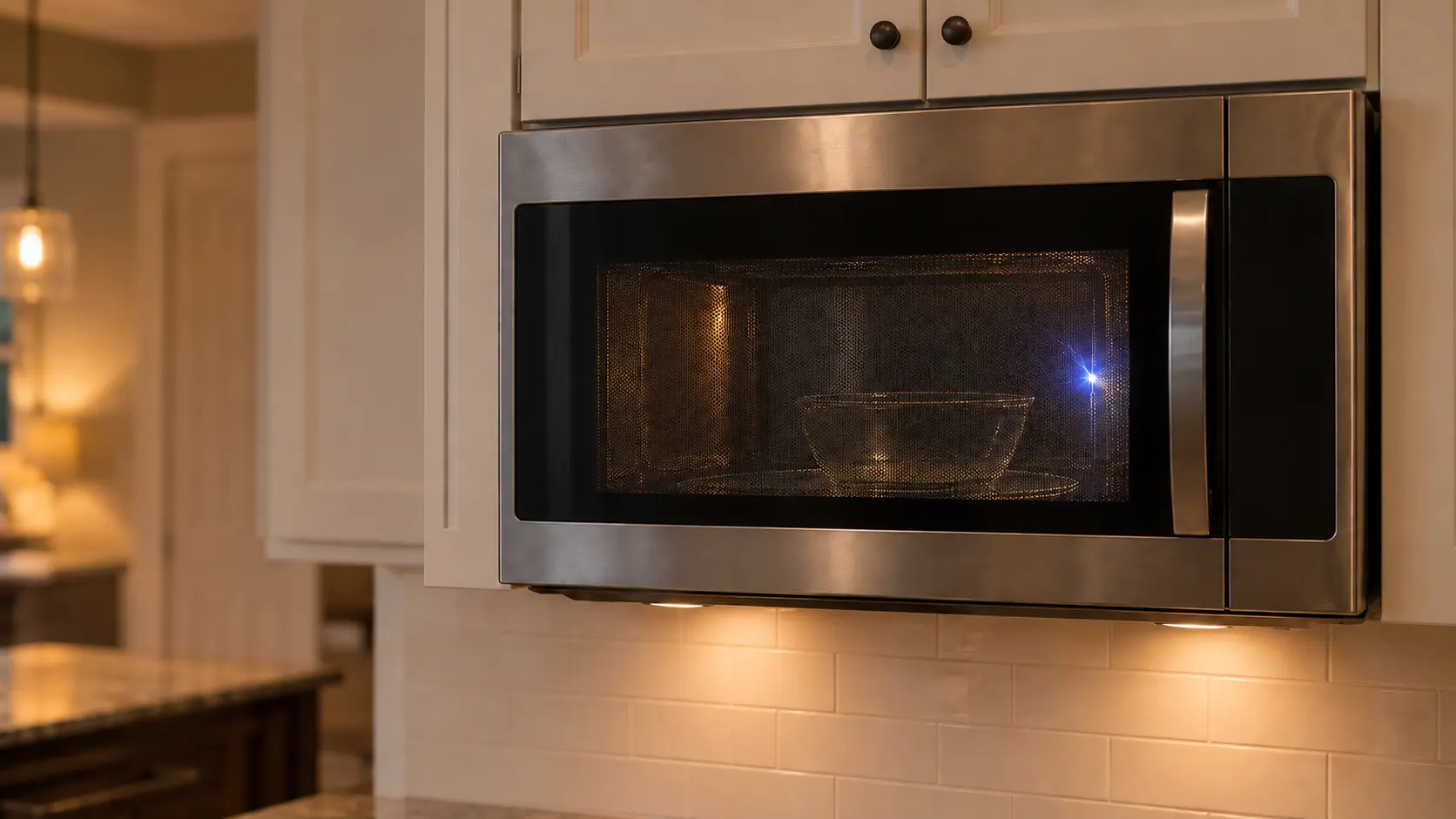
Microwaves bounce off metal, which is why the cavity is a metal box and why the door is built as a metal frame rather than a sheet of glass. The window you look through carries a perforated metal screen: the holes let light out but are far too small for the energy inside to pass. Around the edge, the door meets the front of the cavity with a close metal fit rather than a soft rubber gasket, and a shaped channel in the door edge traps whatever tries to escape through the gap.
The federal standard behind every microwave sold in the United States limits leakage to 5 milliwatts per square centimeter at about 2 inches from the surface, for the life of the unit, and FDA notes that the energy drops sharply with distance: at 20 inches it is roughly a hundredth of the reading at 2 inches. That limit assumes the door is straight, the hinges are tight and the latch closes the way it did in the factory.
The switches behind the latch
The standard also requires two independent interlock systems that stop the energy the moment the latch is released or the door opens, plus a monitoring system that shuts the unit down if one or both interlocks fail. In practice that is a set of small switches behind the latch hooks, pressed in a set order as the door closes. A bent hook or a worn latch that no longer presses them in that order is why a damaged door often shows up as a microwave that will not start, or one that blows its internal fuse the moment the door is shut.
The screen in the window
The mesh sits between two layers of the door. A crack in the outer glass or plastic is a door problem even when the screen behind looks whole, because the layers hold the screen flat against the frame. A dent, a tear or a scorched spot in the screen itself means the door is replaced.
Source: FDA — Microwave Oven Radiation — Leakage limited to 5 mW per square centimeter at about 2 inches for the oven's lifetime, about 1/100 of that at 20 inches; two independent interlocks plus a monitoring system; do not use an oven whose door does not close firmly or is bent, warped or damaged; stop using one that runs with the door open; clean with water and mild detergent, no abrasives; contact the maker about damaged hinges, latches or seals; manufacturers must report defects
Signs the door no longer closes the way it should
A microwave door not sealing rarely announces itself all at once: some signs are obvious and some creep up over months. The last one on the list is the one FDA names outright: a microwave that keeps running with the door open is switched off and not used again until it is repaired.
- The door no longer clicks shut, or has to be pushed or slammed before the microwave will start.
- A visible gap along one edge, or a corner that sits out from the front when the door is closed.
- The door drops or twists when it is opened, a sign of loose or broken hinges.
- Flashes or burn marks on the door edge or the cavity front where they meet.
- The light and the fan keep running with the door open, or the turntable keeps turning.
- The microwave starts, or keeps heating, with the door ajar.
Source: FDA — Microwave Oven Radiation — Leakage limited to 5 mW per square centimeter at about 2 inches for the oven's lifetime, about 1/100 of that at 20 inches; two independent interlocks plus a monitoring system; do not use an oven whose door does not close firmly or is bent, warped or damaged; stop using one that runs with the door open; clean with water and mild detergent, no abrasives; contact the maker about damaged hinges, latches or seals; manufacturers must report defects

Where the door takes its knocks on each kind of microwave
The door problem looks different on each of the four installed kinds, because each one is opened and leaned on in a different way.
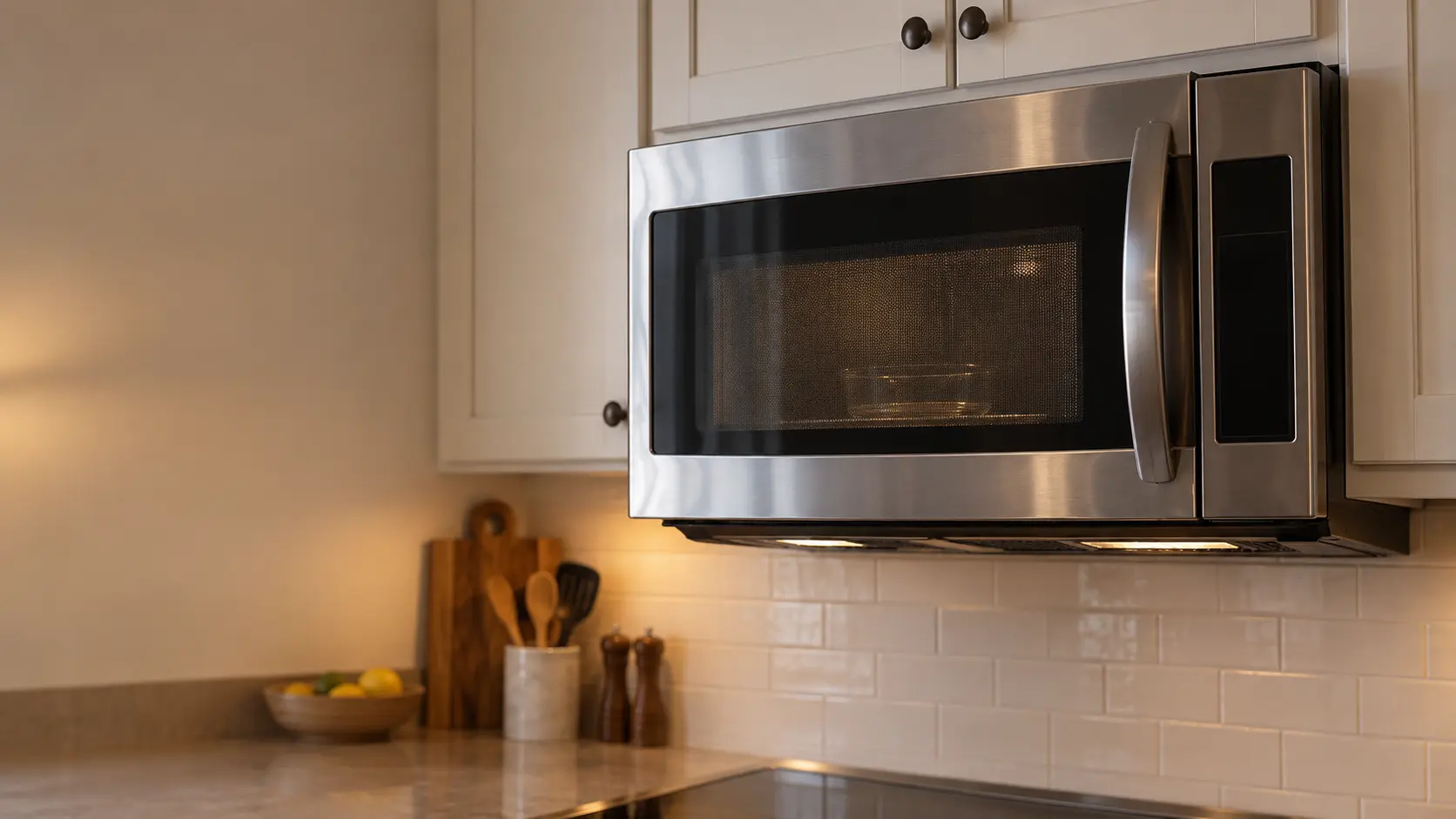
Microwave hood combination
Mounted at head height and opened on side hinges, this door takes the weight of dish towels hung on the handle, children pulling on it to reach, and knocks from pan handles below. It also works in heat and steam rising from the cooking surface, which ages the latch and the hinge pins faster than on a countertop unit.
Built-in and speed models
Some built-in and speed models open downward like a small baking cavity rather than to the side. A drop-down door is a tempting shelf for a heavy dish or a hand leaned on while reaching past it.
Microwave drawers
A drawer seals along its front panel as a motor pulls it shut on guides. Sharp's drawer manual warns against stepping, leaning or sitting on the open drawer and against fingers or clothes near the guides. A drawer that stops short, closes crooked or reopens by itself has a mechanism problem that also affects the seal.
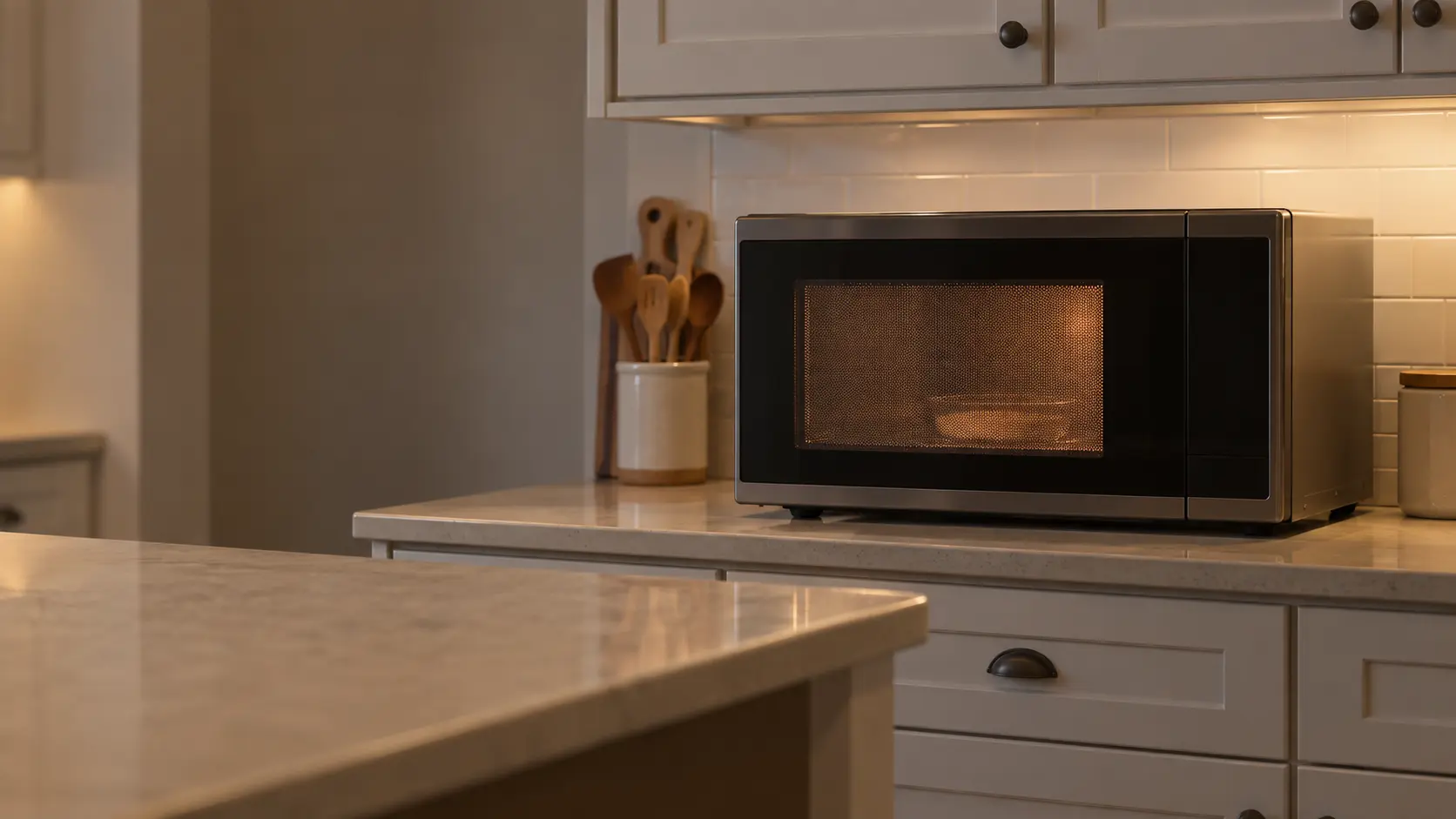
Countertop models
A countertop door usually releases with a push button or a pull handle. The common damage is a door yanked open while the unit is held down with the other hand, or a microwave dropped while being moved, which can twist the whole front out of square.
What an owner can safely look at
With the microwave unplugged, open the door and look at the flat metal face around the cavity opening and the matching face on the inside of the door. Sharp's manual warns against letting food soil or cleaner residue build up on these sealing surfaces and against placing anything between the front and the door; a crust of dried sauce or a folded corner of a paper plate can stop a door closing fully. FDA recommends cleaning the cavity, its outer edge and the door with water and a mild detergent, with no scouring pads, steel wool or other abrasives.
Then close the door slowly and watch it. It should swing freely, meet the front evenly on all four sides and latch without being pushed. If it still sits proud at one corner, catches on the way in or feels loose on its hinges once it is clean, the problem is mechanical.
Home tests worth skipping
- Putting a phone inside and calling it: that shows how the door handles a phone signal, not microwave energy at cooking power.
- Running the microwave with the door propped or the latch taped to see what happens.
- Bending the door, the hinges or the latch hooks back into line by hand.
- Removing the door or the outer cabinet to reach the switches.
Source: FDA — Microwave Oven Radiation — Leakage limited to 5 mW per square centimeter at about 2 inches for the oven's lifetime, about 1/100 of that at 20 inches; two independent interlocks plus a monitoring system; do not use an oven whose door does not close firmly or is bent, warped or damaged; stop using one that runs with the door open; clean with water and mild detergent, no abrasives; contact the maker about damaged hinges, latches or seals; manufacturers must report defects; Sharp — Microwave Drawer SMD2470AS, SMD2470AH, SMD3070AS Operation Manual — Do not place objects between the front and the door or let soil or cleaner residue build up on sealing surfaces; do not operate if the door, hinges, latches or seals are damaged; keep fingers and clothes away from the drawer guides
What the repair involves, and why it is not a home job
Depending on what failed, the repair can be a door assembly, a hinge set, a latch or the interlock and monitor switches behind it, and then a check that the door closes square and the switches operate in the right order. Reaching the switches means taking off the outer cabinet, and inside it sits the high-voltage section: a capacitor that stays charged, sometimes for a long time, after the microwave is unplugged. That is why the outer cabinet is never opened by an owner.
FDA advises contacting the maker if the door hinges, latches or seals are damaged, and manufacturers are required to report radiation defects to the agency. Our technicians find the failed part, replace it and test the door before it goes back into use.
Source: FDA — Microwave Oven Radiation — Leakage limited to 5 mW per square centimeter at about 2 inches for the oven's lifetime, about 1/100 of that at 20 inches; two independent interlocks plus a monitoring system; do not use an oven whose door does not close firmly or is bent, warped or damaged; stop using one that runs with the door open; clean with water and mild detergent, no abrasives; contact the maker about damaged hinges, latches or seals; manufacturers must report defects