
What a fire behind the glass actually looks like
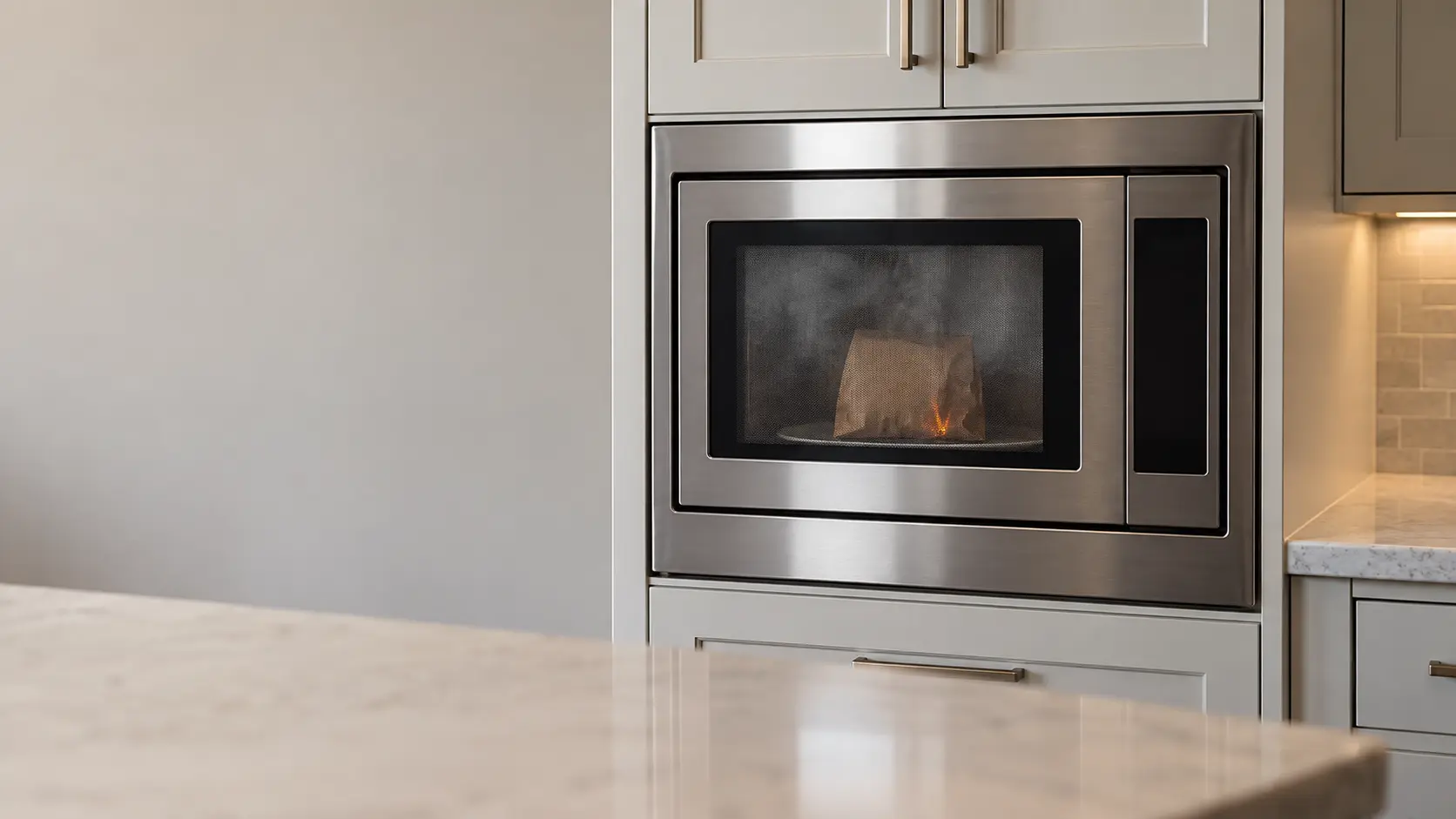
Through the mesh window it rarely looks like a campfire. More often it is an orange glow on one side of the cavity, a lick of flame at the top of a paper bag, or thick gray smoke that fills the box within seconds while the turntable keeps going round.
With a fire inside the microwave, the good news is the shape of the box. A microwave cavity is a small metal chamber with a door that latches shut, and a flame inside it runs out of air quickly once the fan and the magnetron stop pushing heat and air through it.
Sparks first, flame second
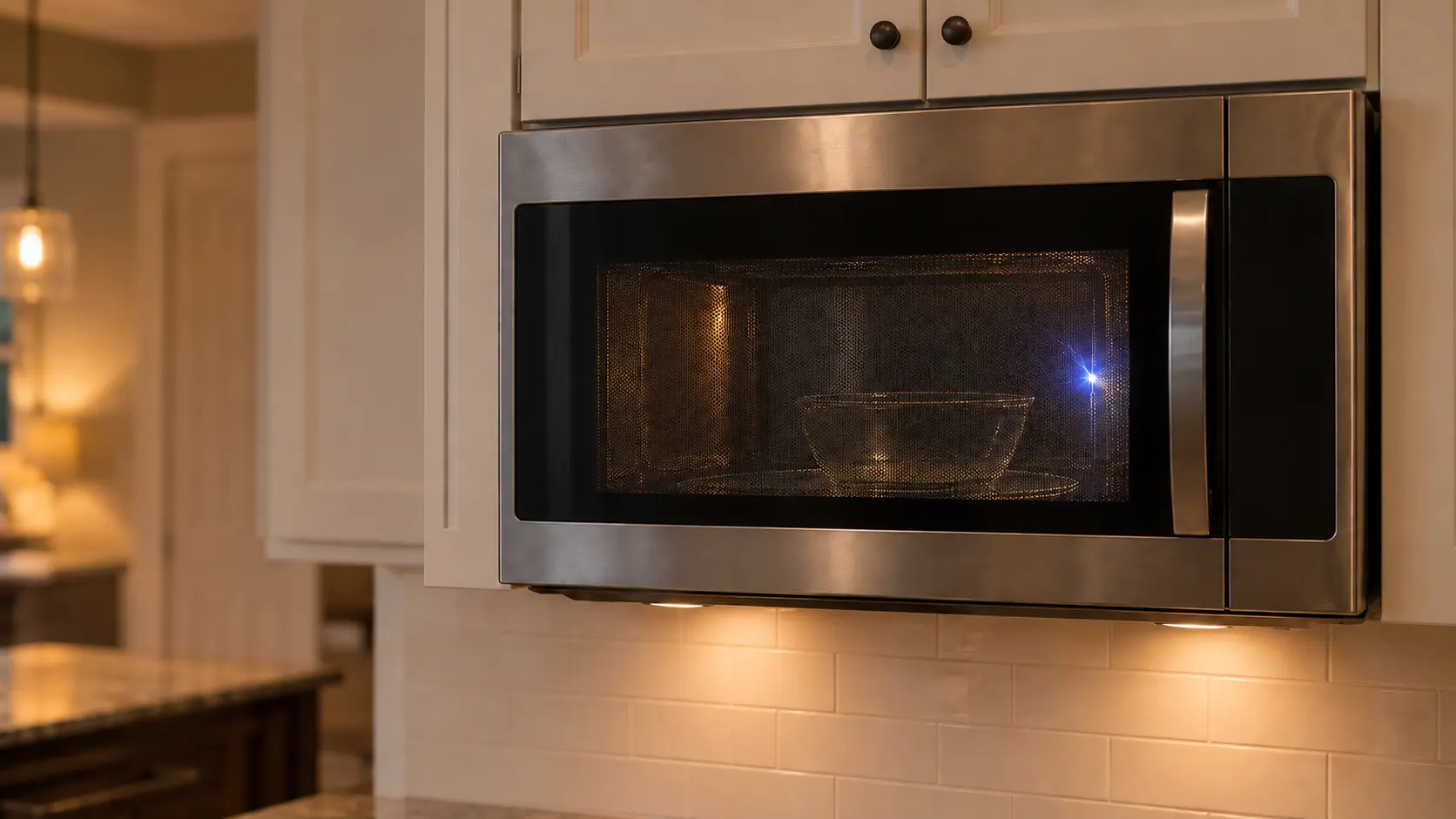
Many fires begin as arcing: blue or white flashes and a crackling sound, usually from metal, a twist-tie or a spot of carbonized food. Arcing on its own is a reason to press stop straight away. If it is allowed to continue, the spot it strikes heats up, and paper or food nearby can catch.
Smoke with no visible flame
Dense smoke and no flame usually means food has dried out and charred, which Sharp's drawer manual names directly: severely overcooked food can smoke or ignite. Treat it exactly like a fire. The door stays shut until the smoke inside has stopped moving and thinned.
The first minute: door shut, stop pressed, power cut
Sharp's safety instructions spell out the order: if materials inside ignite, keep the door closed, turn the microwave off and shut off power at the fuse or circuit breaker panel. NFPA's tip sheet says the same in household terms: leave the door closed, turn the unit off and unplug it from the wall.
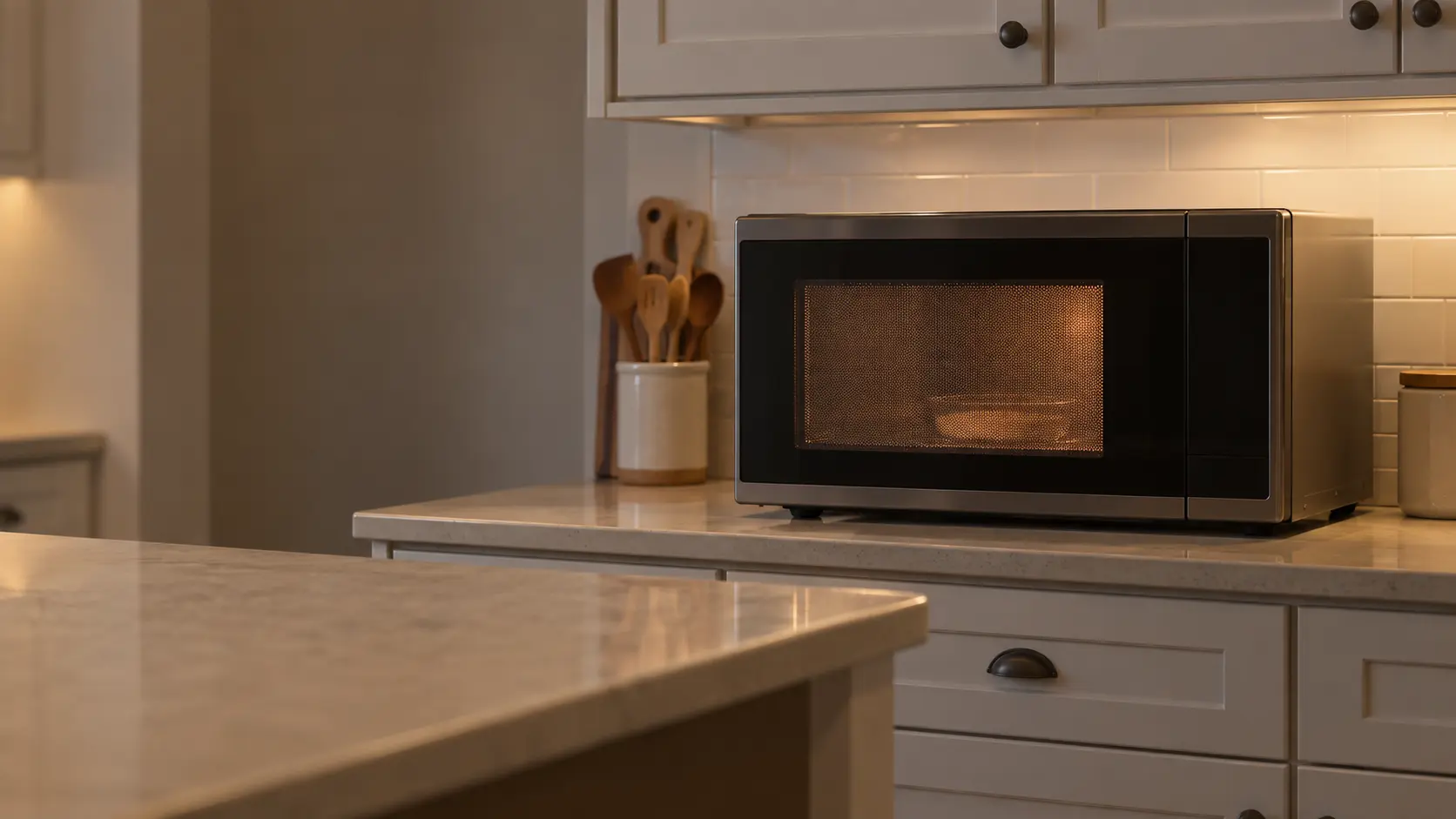
Which of those you do depends on where the plug is. A countertop model is usually plugged in behind it on the backsplash. A microwave hood combination is plugged in inside the cabinet directly above it, which means reaching up over the heat and opening a cabinet door; go to the panel instead. Built-in and drawer models are plugged in inside the cabinetry around them and are almost always quicker to cut from the panel.
- Press stop or cancel once to end the cycle and turn off the fan blowing across the cavity.
- Unplug from the wall only if the plug is within easy reach and away from the smoke.
- Otherwise, switch off the breaker marked for the microwave or the kitchen.
- Move people and pets back from the kitchen and keep an eye on the window from a distance.
A microwave drawer on fire
A drawer opens with a motor at the touch of a pad, so the risk is opening it by reflex. Do not touch the control area once you have pressed stop. Sharp's drawer can also be locked from its panel, which disables the automatic opening, but in a fire the breaker is the simpler way to make sure nothing moves.
Source: Sharp — Microwave Drawer SMD2470AS, SMD2470AH, SMD3070AS Operation Manual — If materials inside ignite, keep the door closed, turn the microwave off and shut off power at the breaker; severely overcooked food can smoke or ignite; remove twist-ties; do not store paper products inside; food residue on the waveguide cover can cause arcing and fires; Control Lock disables the panel and automatic door; NFPA — Microwave Oven Safety tip sheet — If you have a fire in the microwave, leave the door closed, turn it off and unplug it; if the fire does not go out, get outside and call the fire department; Sharp — Over the Range Microwave Oven Installation Instructions (R-1881LSY and related models) — The receptacle for a hood combination is located inside the cabinet directly above the unit, and the unit is screwed to the top cabinet

If the flames do not die down
Most small fires in a closed cavity go out within a minute or two once the power is off. If the flame is still growing, if smoke is coming out around the door or from the vents in the cabinet, or if the cabinet above is getting hot, NFPA's advice is plain: get outside and call the fire department from there.
Do not open the door to throw water, flour or anything else at the fire, and do not try to carry a burning microwave outside. Opening the door gives the fire air and, with a hood combination, puts the flame at face height directly below the wall cabinets.
Why the cabinet above matters on a hood combination
A microwave hood combination hangs from the wall with its top screwed to the underside of a wood cabinet, and its cord runs up into that cabinet. Heat from a long fire can scorch that wood and the cord. If the cabinet bottom is hot to the touch or the smell is coming from the cabinet, treat it as a house fire, not an appliance problem.
Source: NFPA — Microwave Oven Safety tip sheet — If you have a fire in the microwave, leave the door closed, turn it off and unplug it; if the fire does not go out, get outside and call the fire department
What usually sets the inside alight
Almost every fire in a microwave traces back to what was put in it or how long it ran. Makers repeat the same few warnings in their manuals, and USFA's national figures point the same way for kitchen fires in general: unattended cooking is the leading factor behind the ones that spread.
- Food left far too long: popcorn run past the popping, a potato forgotten at full power, bread dried to charcoal.
- Paper and plastic used to help the cooking without anyone watching, which Sharp's manual singles out for close attention.
- Metal twist-ties left on a bag; Sharp's instructions say to remove them before the bag goes in.
- Paper towels, napkins or cookbooks stored inside between uses, which the same manual says not to do.
- A splattered waveguide cover: the flat panel on a cavity wall that covers the opening where the energy enters, where caked food can arc and burn.
- Running the microwave empty, which FDA notes some models should never do.
The waveguide cover and old splatter
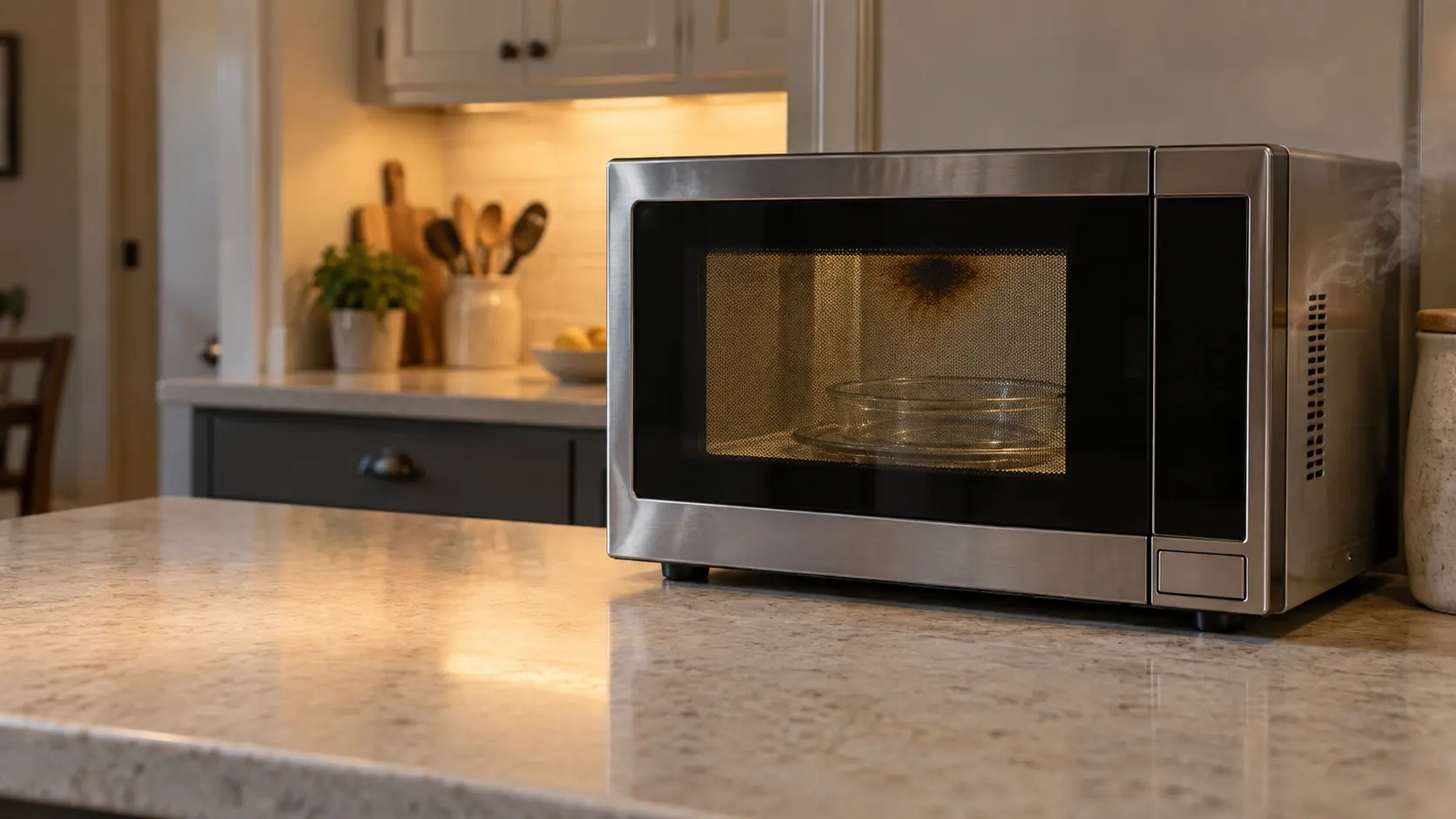
Sharp's drawer manual tells owners to keep the waveguide cover clean because food residue on it can cause arcing and fires. A cover with a dark, pitted spot has usually been arcing for a while. Clean it gently with the unit unplugged; a cover that is burned through is replaced, not patched, and running the microwave with a hole in it invites the next fire.
Source: Sharp — Microwave Drawer SMD2470AS, SMD2470AH, SMD3070AS Operation Manual — If materials inside ignite, keep the door closed, turn the microwave off and shut off power at the breaker; severely overcooked food can smoke or ignite; remove twist-ties; do not store paper products inside; food residue on the waveguide cover can cause arcing and fires; Control Lock disables the panel and automatic door; FDA — Microwave Oven Radiation — Some ovens should not be operated when empty; U.S. Fire Administration — Cooking Fire Safety — Unattended equipment was the leading factor contributing to ignition in nonconfined home cooking fires
After the flames: what to look at and what to leave alone
Once the smoke has thinned and the cavity has cooled for several minutes, open the door slowly, with your face turned away, and let the room air out. A light film of soot on the walls can be wiped with warm water and mild detergent once the unit is cold and unplugged.
What you cannot see matters more. The magnetron, the high-voltage transformer, the capacitor and the wiring sit behind the cavity walls, and a hot fire can reach the insulation on those wires or crack a plastic part near the vents. The outer cabinet is never opened by an owner: the capacitor in the high-voltage section stores energy and does not give it up just because the plug has been pulled.
Signs it must stay unplugged
- A scorched or bubbled cavity wall, or paint lifting in the ceiling of the cavity.
- A burned or holed waveguide cover.
- A cracked, smoked or warped door window.
- A smell of hot wiring or plastic that lingers after the food smell is gone.
- A breaker that tripped during the fire, or a door that no longer closes cleanly.