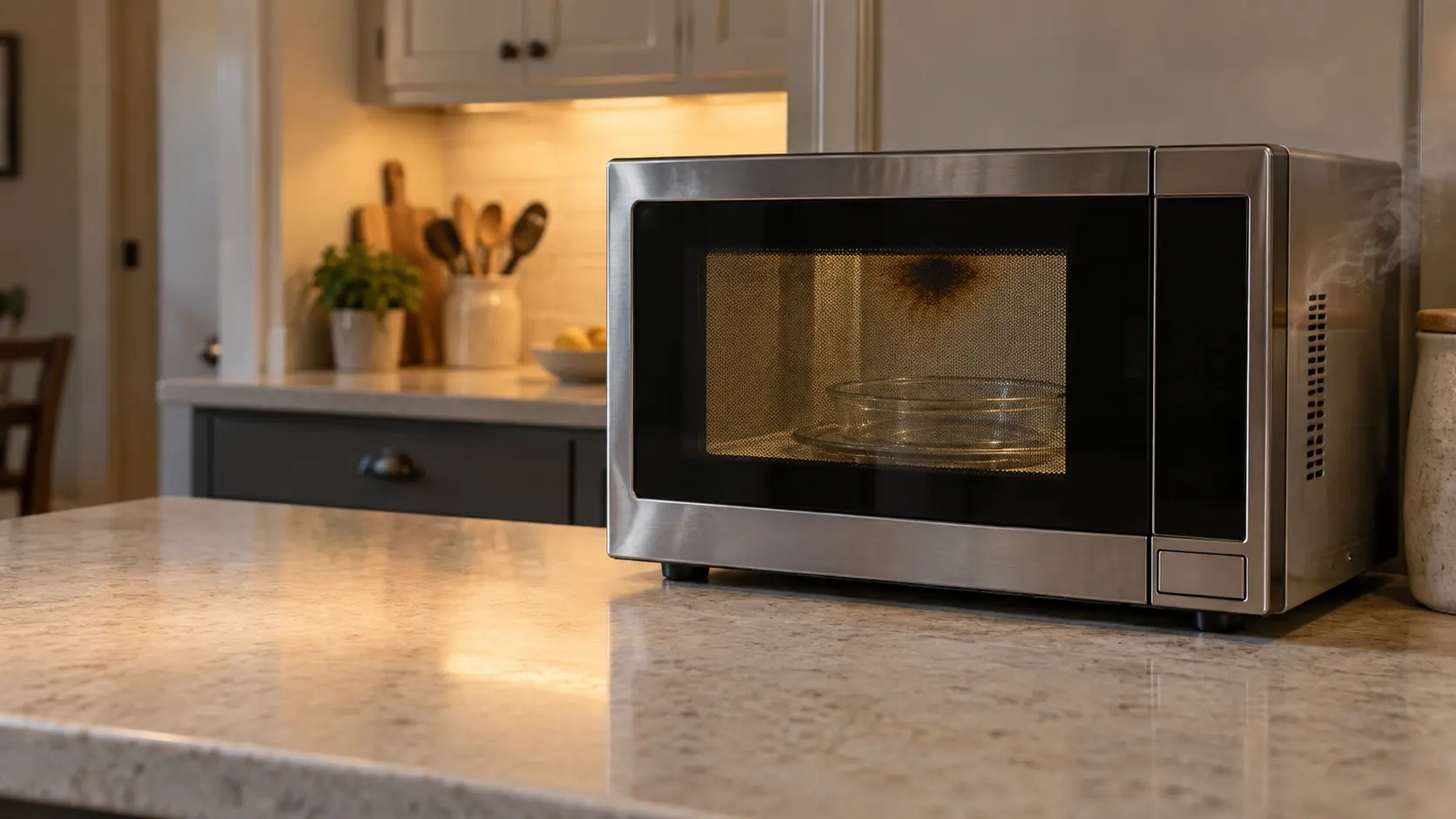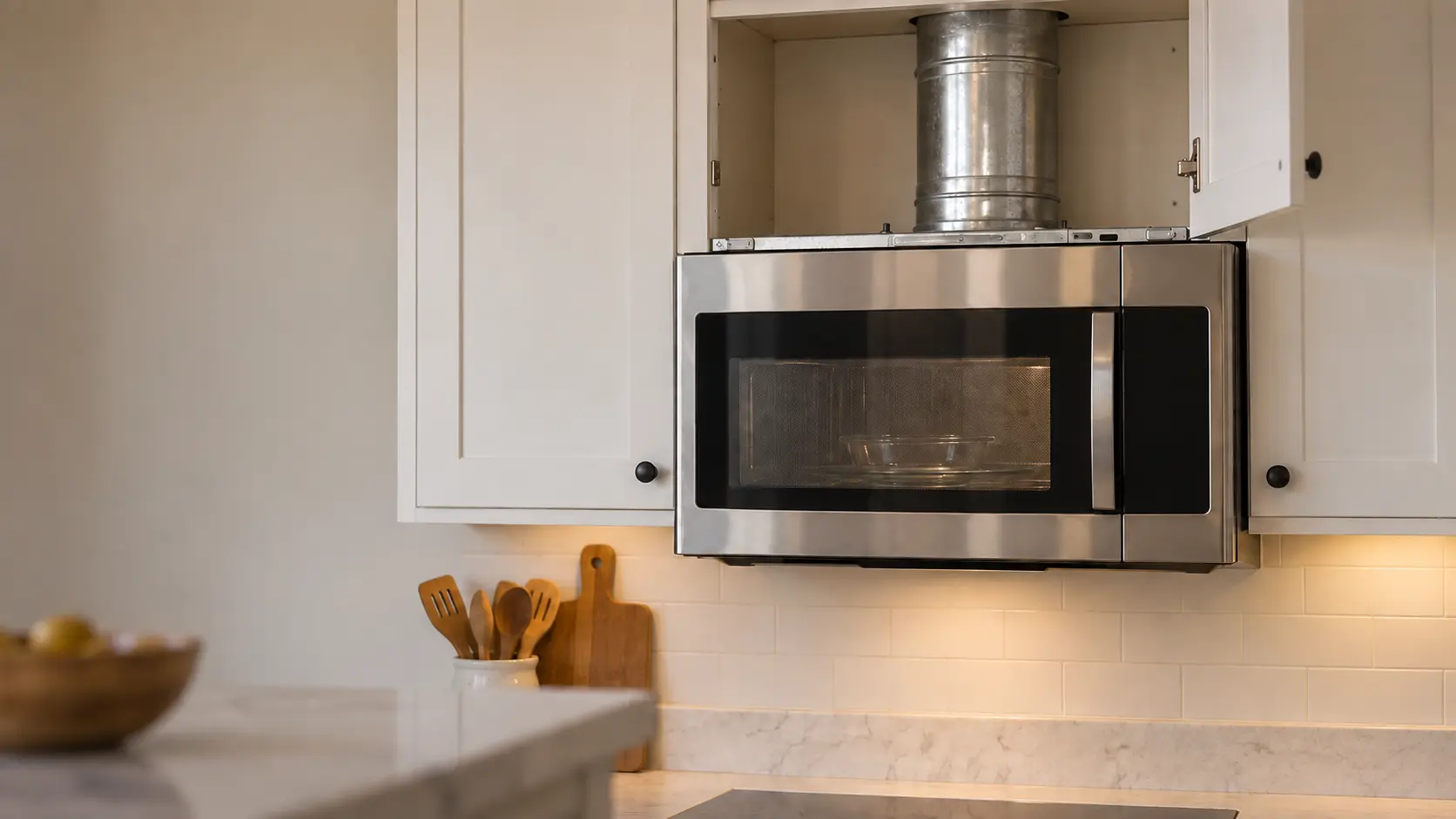

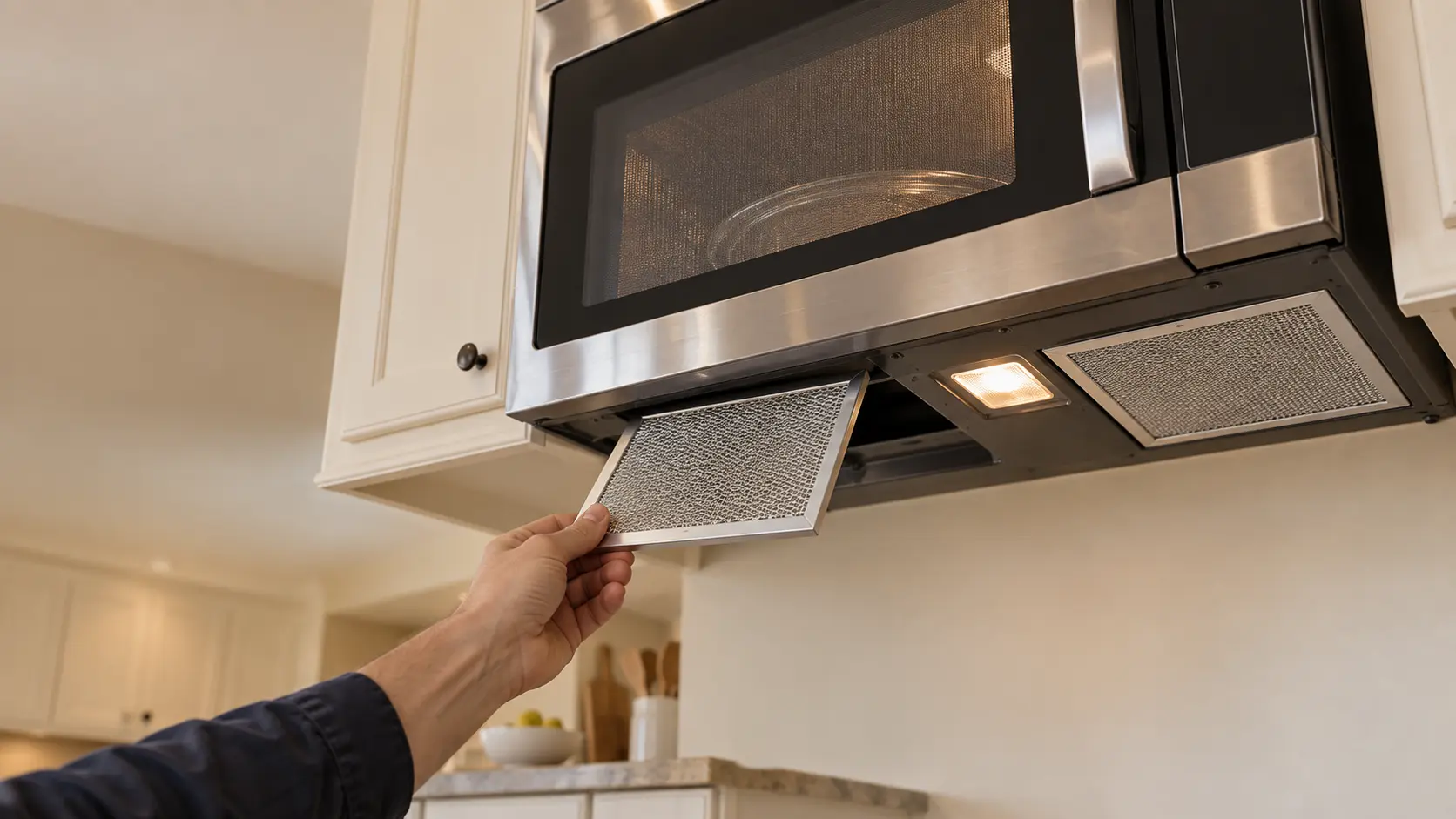
Two ways the microwave's vent fan can move air
Either way, the air goes in through the grease filters on the underside of the microwave. Ducted outside, the fan pushes it up through the top of the unit or straight back through the wall behind it, into a metal duct that ends at a cap on the roof or an outside wall. Recirculating, the fan pushes it through a charcoal filter and out of the grille above the door, back into the kitchen.
Makers ship their units in different states. Sharp's installation instructions say its hood combination arrives assembled for recirculating; GE's support page says its units leave the factory set to vent out of the top. Either one can be changed, but only before the microwave is hung.
Up, back or into the room
Sharp describes three setups: recirculating, horizontal exhaust out of the back, and vertical exhaust out of the top. Changing from one to another means turning the fan unit inside the microwave and fitting an exhaust damper to the mounting plate or to the top of the case. That is installer work done before mounting, following the model's instructions, and it is not something to attempt on a microwave that is already on the wall and plugged in.
Source: GE Appliances — Over-the-Range Microwave: Ducting Information — Units ship to vent out the top; 140 equivalent feet of 3-1/4 by 10 inch or 6-inch round duct; smaller or larger ducts reduce performance; equivalent feet for adapters, caps and elbows; no common ductwork; do not vent into an attic or crawl space; plastic or cardboard duct not recommended; 7-inch round up to 150 feet, 8-inch up to 250 feet; Sharp — Over the Range Microwave Oven Installation Instructions (R-1881LSY and related models) — Shipped assembled for recirculating; three ventilation setups with the fan unit rotated and an exhaust damper fitted; ductwork must be metal, never plastic; 3-1/4 by 10 inch or 6-inch round duct no longer than 140 equivalent feet; charcoal filter replaced every 6 to 12 months
What makes a duct run work
GE's ducting guidance and Sharp's installation instructions agree on the essentials. The duct is 3-1/4 by 10 inches rectangular or 6 inches round, reached through a rectangular-to-round adapter; both smaller and larger ducts than recommended reduce performance, according to GE. All of it is metal, and Sharp says plainly not to use plastic duct.
The total run is counted in equivalent feet: the straight duct plus a figure for every fitting, because each bend and cap resists the air as much as a longer stretch of straight pipe. GE and Sharp both set 140 equivalent feet as the limit for the standard sizes.
| Fitting | Equivalent feet |
|---|---|
| Rectangular-to-round transition adapter | 5 |
| Wall cap | 40 |
| Roof cap | 24 |
| 90-degree rectangular elbow | 25 |
| 45-degree rectangular elbow | 5 |
| 90-degree round elbow | 10 |
| 45-degree round elbow | 5 |
Counting a real run
Take a common layout: out of the top, one 90-degree rectangular elbow to turn toward the outside wall, and a wall cap. The elbow counts 25 feet and the cap 40, so 65 of the 140 are gone before any straight duct is counted, leaving 75 feet for the straight sections. Swap the rectangular elbow for a round one after a transition and the fittings cost 55 instead. GE adds that a run over 140 equivalent feet can move up to 7-inch round duct, good for 150 feet, or 8-inch, good for 250.
Where the duct must not end
- Into an attic or a crawl space, which GE rules out.
- Into a duct shared with another fan or appliance; GE says the microwave cannot be ducted into common ductwork.
- Through flexible plastic or cardboard duct.
- At a wall cap without a working damper flap, which lets outside air and pests back in.
Source: GE Appliances — Over-the-Range Microwave: Ducting Information — Units ship to vent out the top; 140 equivalent feet of 3-1/4 by 10 inch or 6-inch round duct; smaller or larger ducts reduce performance; equivalent feet for adapters, caps and elbows; no common ductwork; do not vent into an attic or crawl space; plastic or cardboard duct not recommended; 7-inch round up to 150 feet, 8-inch up to 250 feet; Sharp — Over the Range Microwave Oven Installation Instructions (R-1881LSY and related models) — Shipped assembled for recirculating; three ventilation setups with the fan unit rotated and an exhaust damper fitted; ductwork must be metal, never plastic; 3-1/4 by 10 inch or 6-inch round duct no longer than 140 equivalent feet; charcoal filter replaced every 6 to 12 months

Recirculating: what the charcoal filter can and cannot do
A charcoal filter traps cooking odors; it does not take out heat or steam, which come straight back into the room above the door. It works behind the grease filters, so the grease filters still do their job of catching fat before it reaches the fan. For a kitchen with no practical route outside, recirculating is the honest compromise, and for most reheating and light cooking it is enough.
GE explains how its charcoal filters sit: loosely, in a compartment behind the vent grille, held in place only once the fan starts. The filter may be smaller than the opening and not cover it completely, which is normal, and it is specific to the model, so the replacement has to match the number listed in the installation instructions or specifications. GE also notes the black charcoal side faces down and the shiny side up.
How often the charcoal filter is changed
Sharp gives 6 to 12 months depending on use. A household that fries or sears most nights sits at the short end, one that mostly reheats at the long end. A charcoal filter cannot be washed back to life; the grease filters in front of it can, and keeping those clean is what makes the charcoal last.
Source: GE Appliances — Over-the-Range Microwave: Charcoal Filter Size and Fit — A charcoal filter is used when air is recirculated; it sits loosely behind the vent grille and is held by the fan; it may not cover the whole opening; filters are model specific; GE Appliances — Over-the-Range Microwave Charcoal Filter Kits — Install the charcoal filter with the black side down and the shiny side up; the filter number is listed in the specifications and installation instructions
Choosing between them in a real kitchen
The decision is usually made by the wall, not by preference. Whether you can vent a microwave outside depends on what sits behind and above the opening: an outside wall, a run through the cabinet above to the roof, or an existing duct left by a previous installation.
- An outside wall directly behind the microwave: a short rear exhaust with a wall cap is the simplest ducted setup.
- An inside wall with a cabinet above and a roof or outside wall within reach: vertical exhaust through the cabinet.
- An apartment or condominium where exterior walls cannot be cut: recirculating.
- An existing duct from an old unit: check its size, material and damper before reusing it.
- Heavy searing, frying or wok cooking below: the case for ducting outside is strongest.
Signs the venting was set up wrong
Most complaints about a weak or noisy vent fan on a microwave hood combination turn out to be the installation rather than the motor. These are the ones worth recognizing before booking a fan repair.
- Air blows out of the grille above the door even though a duct is connected, meaning the fan was never turned for outside venting.
- A flapping or rattling sound from the top of the unit: a damper that is missing, stuck or fitted the wrong way.
- Grease dripping from the duct connection or the cap, usually from a long run with too many elbows.
- A strong fan sound with little suction at the filters, typical of a run well past its equivalent length.
- Cooking smells hanging on in a recirculating kitchen: an old or missing charcoal filter.